

I rarely feel peaceful these days.
What I mostly feel is anger at a ceasefire that doesn’t hold in Gaza, and a fractured Sudan we forgot. I’m horrified when I see photos of crying Liam Conejo Ramos, illegally seized with his father by U.S. immigration agents. Liam, who is just 5 years old, was terrified. I couldn’t help but think of my own child.
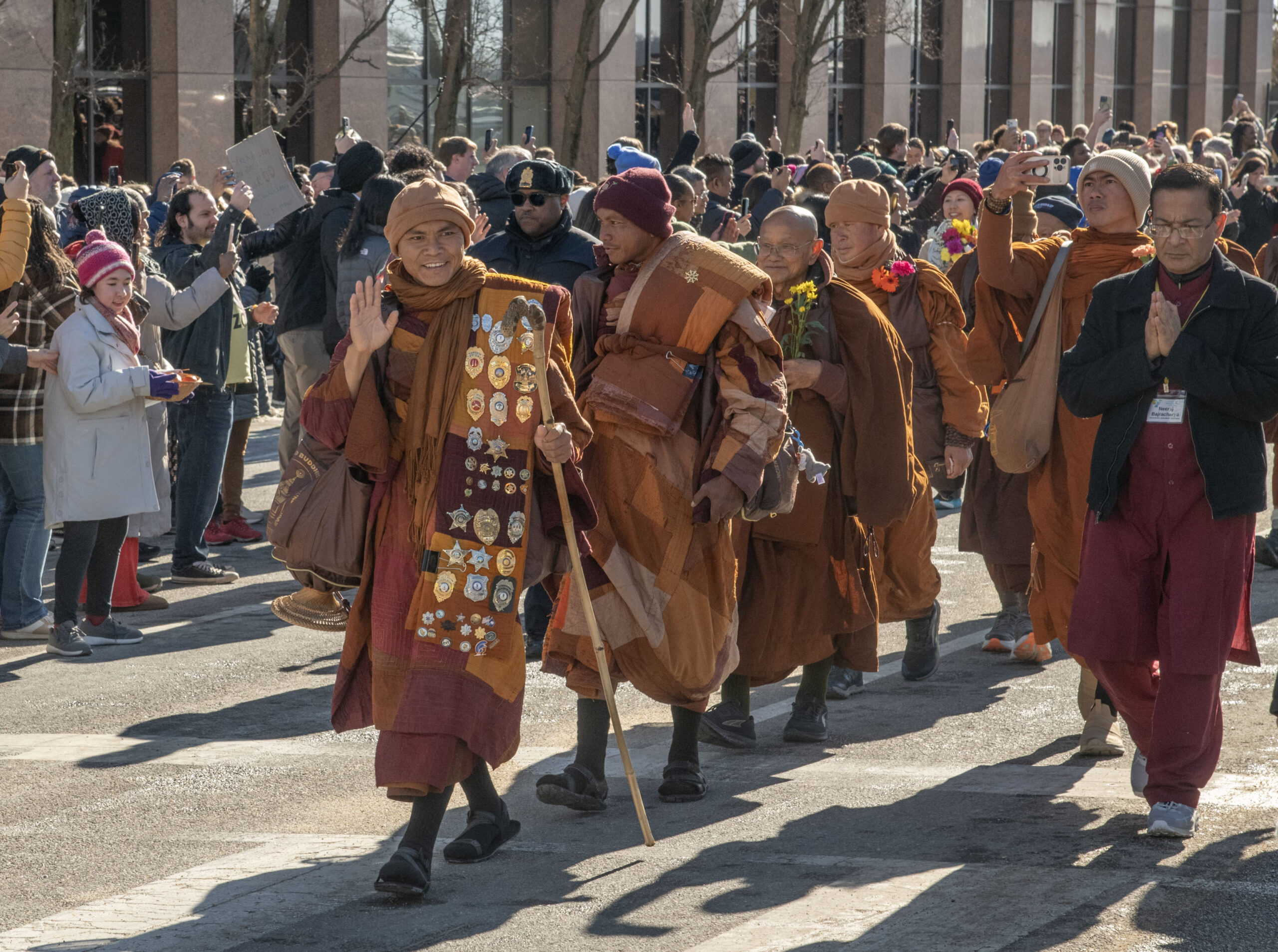
I waited in the snow with my 7-year-old son, Peyton, to see the monks on their Walk for Peace as they passed through Richmond on Monday. That was when I remembered that peace isn’t a feeling — it’s a choice.
Black and brown people have a legacy of choosing peace, even when we are righteously angry.
It’s fitting that on the 100th day of the Walk for Peace from Fort Worth, Texas to D.C., the monks traveled through the former capital of the Confederacy, 100 years after Black History week (which would later become month) was first observed.
It’s a meaningful moment to recognize a Black man who chose peace, even when it was hard. More than a decade ago, as a reporter for The Progress-Index in Petersburg, I met Carl Winfield, a member of the Southern Christian Leadership, which mobilized the massive peaceful protests led by Martin Luther King Jr.

The SCL tapped Winfield to help organize a march that would take King and fellow activists from Suffolk to Petersburg to D.C. — nearly 200 miles — as part of King’s Poor People’s Campaign.
“Dr. King was supposed to go to Suffolk, because we were boycotting Suffolk, against a hospital,” Winfield recalled,“Then from the hospital, they were going up to Washington.”
Unexpectedly, King instead traveled to Memphis to resolve a strike, after two sanitation workers died due to unsafe job conditions.
King’s decision was sadly fateful — he was assassinated on April 4, 1968, while in Memphis.
Petersburg, Winfield’s hometown, is a small southern city, whose huge role in the Civil Rights movement isn’t as talked about as that of neighboring Richmond. King visited Petersburg on numerous occasions in the 1950s and ‘60s. King’s chief of staff, Wyatt Tee Walker, was a Petersburg native who brought peaceful tactics from protests in the city, to the larger national civil rights movement.

Before Richmond, the monks stopped in Petersburg, resting for a night at Virginia State University. Students of the historically Black college led protests against segregation in Petersburg.
After King’s death, Winfield kept walking for peace and equality.
In 1968, the Virginia leg of the Poor People’s Campaign still went forward. And as an older man in 2009, Winfield marched from Petersburg to Washington to commemorate the election of President Barack Obama.

In 2013, when I met him, Winfield marched again from Suffolk to Petersburg in protest of poverty, and to commemorate King.
“I am doing what I need to do because he [God] put me in places to finish what I need to do,” Winfield told me.
Winfield died in 2018 at the age of 70. But I think he and the monks would have had a lot to discuss about the power of peaceful demonstrations. He surely would have braved the snow and ice to meet them.
I remember Winfield as kind, always with a warm smile and soft spoken. Like the monks, he carried a wooden walking stick and had the discipline to keep his feet moving.
He didn’t seem to struggle with living a life of peace, like I do.
And I think other Black and brown people do, too. We live under the yoke of systemic racism, during the term of a president who views us as subordinate. We’re part of a society that doesn’t allow Black or brown people to be disruptive or radical, despite the injustice we face.
The monks have passed through southern cities with histories of inequality more recent than many people acknowledge. And their journey is just five years after Black Lives Matter protests — largely known to be peaceful — were sparked by the killing of George Floyd.

Though I abhor violence, I sometimes wonder if peace is enough. But the monks have reminded me that peace doesn’t mean submission. The most powerful statement is often staying calm when it’s the unexpected response, when you have every right to be livid.
I think peace is also found in being kind when there is madness around us. Peace is in small gestures.
I saw many demonstrations of peace when the monks came to Richmond. Peace was in the woman who distracted my son from a tantrum, while he stood in the snow. And it was in the daisies Peyton brought her that had fallen on the ground, before they could be offered to the monks.
There was peace when thousands of people walked with the monks across the James River, to city hall, where Virginia’s first female governor, alongside our first Muslim lieutenant governor, commemorated their journey.
“To see thousands of people choosing to walk together for peace … to feel the power of that collective intention moving through the streets of Richmond — this was beyond anything we could have imagined,” Walk for Peace organizers wrote.
Keep choosing peace.
A longtime contributor to Style Weekly, Leah Small is a Richmond-based freelance journalist with bylines in Scientific American, The New York Times and The Guardian.