
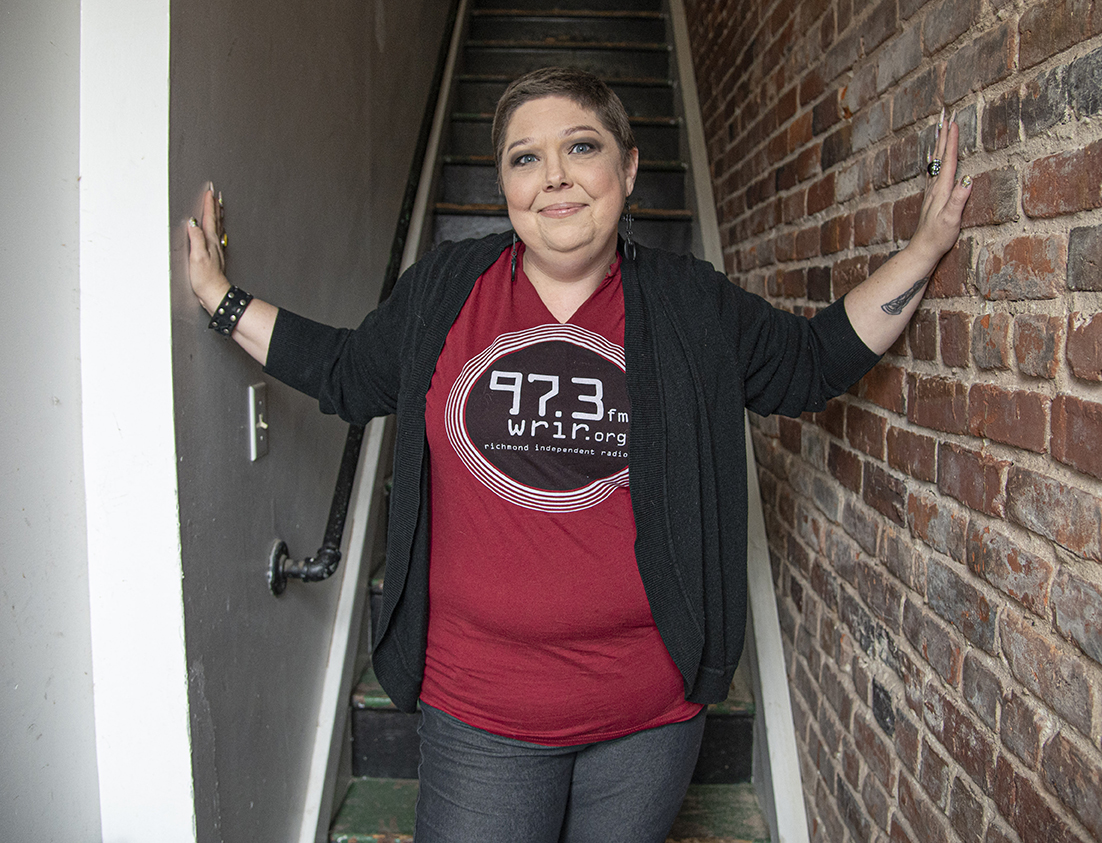
Melissa Vaughn, who died on Jan. 29 after a long battle with cancer, wasn’t afraid to be a squeaky wheel. In fact, she relished it.
Last year, when the local arts advocacy organization CultureWorks was about to embark on an unusual “Shark Tank”-like event to facilitate its annual arts grants — pitting small cultural organizations against each other in public — the head of WRIR 97.3 FM spoke out forcefully against it. “It’s already hard enough out here for small to mid-sized nonprofits to get funding,” Vaughn told Style Weekly, “especially in arts and culture.”
Despite the fact that the nonprofit WRIR badly needed money — having just embarked on a $2 million dollar capital campaign to move to a new location — she withdrew the station’s application for funding. In the end, her outspokenness helped to halt the proceeding and arts grants were eventually awarded as they normally had been.
The past president of the Virginia Center For the Public Press, the parent organization of WRIR, Vaughn loved fighting for what she thought was right. Some of those eulogizing her after her death, like journalist and radio host Charles McGuigan, called her “a force of nature.” “She stood for the most marginalized members of our community,” he says. “And she stood firm, and would not back down.”
The volunteer staff at WRIR, cited as one of the most successful low-power stations in the country, posted on social media after her passing: “Over the years, Melissa ran and contributed to countless WRIR shows, trained more volunteers, built and strengthened this community radio station, and left her indelible imprint on our airwaves and our lives. Her voice, knowledge, dedication, and mentorship shaped WRIR in ways that will be felt for a long time to come.” (WRIR is still reeling from the death of longtime “Global A Go-Go” host Bill Lupoleti this past October.)
The testimonials and the memories from her colleagues and friends speak volumes about who she was. DJ Sean Lovelace recalls a Women in Radio initiative that she helped to coordinate (“I think Melissa really made a point to celebrate her fellow femme volunteers and center them at a station that, at times, could be chummy and boy’s club-ish”). Talk show host Patricia Stansbury, a.k.a. Sunny Gardner, remembers how Vaughn was always available to help news-talk hosts record their segments, and recalls how warmly Vaughn treated her after she’d been put on suspension (“she welcomed me back, saying my voice was needed”). Dina Weinstein, the former co-host of Open Source RVA, will never forget the student radio camps Vaughn helped her organize at the station, including one where students interviewed Richmond Public Schools Superintendent Jason Kamras (“It was the true essence of WRIR, giving voice to underrepresented voices through an open door.”)

“There’s few people that kind of embody what WRR stands for, should stand for, and what people hope it would stand for better than Melissa,” says VCPP board member Doug Nunnally. “It was her original personality, but also her fire. That fire, it didn’t just get things done, it pushed everyone else to get things done.”
When Melissa stepped down from her leadership role in September of last year to fully concentrate on her cancer treatments, she passed the leadership baton to Bridé Baker, who is now the president of the VCPP.
“I met Melissa in 2016 when we both had just begun volunteering with WRIR,” Baker says. “I’ve been trying to think of a story that encapsulates who she was. I’ve never held a drivers license, and in my early 20s had to bike upward of 10 miles a day to get to and from work. This involved being in traffic a lot. I remember telling Melissa that a well-meaning fellow volunteer had pushed me out of traffic to wave at me on my bike from their car window. I had just meant to vent about a frustrating reality but Melissa turned around and immediately found the volunteer to tell them exactly how they had fucked up, putting me in danger with their gesture.”
Baker was flabbergasted, “but for Melissa this was a standard way of handling the misbehavior of those around her, directly, unapologetically, always in defense of someone more vulnerable.”
“She would dig in,” echoes Jessee Perry, Vaughn’s partner in RVA Dirt, which covered local politics on WRIR and Twitter. “If she believed in something, and she knew that it was right, she would 100% go chips on the table. She would get very passionate and stern about her opinions, especially if she felt injustice. it’s a lot different from my approach, which is like, let’s all find a way to common ground, but it was nice to have a person like Melissa who was willing to put her foot down and, and say, like, ‘No, we’re not gonna tolerate this. You are wrong.'”
Vaughn was aware that her forceful demeanor — often expressed while wearing her trademark garish leggings — turned some people off, and that was OK. “Sometimes people find me a lot to take,” she said last year. “You know how it takes a lot of people a long time to get to the point where they’re okay with themselves, or the way that people perceive them? I was cool with me very early on.”

A magical childhood
The woman who called herself One Hit Wanda was born Melissa Susan Martin on March 28, 1979 in Chesterfield, the only child of Martin and Kathleen Martin. She attended Jacobs Road Elementary school at the same time as her future husband Jerry Vaughn, although they didn’t meet each other until much later.
Last year, in an in-depth interview with Charles McGuigan for his “A Grain of Sand” radio program, Vaughn described her childhood as “beautiful and special and my parents made it magical and I never understood why my friends didn’t have the same.”
When she was 11, Melissa Vaughn turned on the TV to the local cable access channel, and her life changed. “I stumbled upon channel 57 and that started my lifetime obsession with Richmond City Council,” she told McGuigan. “It was like my soap opera.”
She described her younger self as “the outspoken kid who had all of the nerd friends. If they got picked on, I went for the bully. That was my thing. A really strong sense of justice.” She graduated from Manchester High School and attended Longwood College, majoring in history and political science, but just for a year. “I hated it. I hated Farmville because they’re racists. It was gross being there.”
She worked as a temp in Northern Virginia for a time, but River City, or specifically Jerry, who she met at a Fighting Gravity concert at Innsbrook, called her home. The 20-year-olds got married, settled in Richmond and she worked a variety of jobs, including as a maid and babysitter. Melissa briefly considered enrolling at VCU but it never happened. “I never went back to school,” she said. “Why? Because I’m a lifelong learner on my own… I was the kid who read all of the encyclopedias from cover to cover, memorized the trivial pursuit cards. I’m the one you want on your team. I have the capacity for that but I couldn’t tell you where my keys are.”
She was an early user of Twitter and used it to explore her longtime passion, she told McGuigan. “I really love local politics. I don’t have any sort of degree in any of it but … I taught myself how our local government works.”
Vaughn’s attraction eventually led her to start covering city council meetings on social media under the RVA Dirt moniker, alongside her friend Jessee Perry, who she met when Perry ran for Richmond School Board in 2016, Later, Francesca Leigh-Davis joined the team.”We realized that there were all of these candidate forums happening, and that the same people were showing up to them,” Perry recalls.
“We both wondered how we were actually going to pick a good candidate that’s gonna be good for Richmond, whether that be mayor, city council, or school board, when there’s like 50 bajillion forums and people aren’t coming to them. So we decided to take it to the TwitterVerse and live tweet the candidate forums. We ended up having the same common shared interest and passion for disseminating as much information as possible.”
RVA Dirt became known for info, yes, but also snarky commentary and irreverent humor that actually made city government seem fun. Late in 2016, RVA Dirt began filing Quick and Dirty Council Roundup reports for WRIR’s “Open Source RVA” show. It was there that another obsession grew for Vaughn: community radio. “When I was editing her segments, she always stayed late watching me put them together,” says Krysti Albus, the former “Open Source RVA” producer who recruited her to the station and trained her. “She eventually started doing it on her own.”
One Hit Wanda revealed herself to be anything but a one-trick pony. Once at WRIR, among other things, she became the station’s volunteer coordinator, co-chaired its News and Public Affairs Committee, and co-hosted not only one of its most popular news-talk shows, RVA Dirt’s “Municipal Mania,” but eventually a music show called “Unicorn Power.” “When I heard she was doing the ‘Unicorn Power,'” Perry says. “I thought, that really fits her. She really was a unicorn, one of a kind, a shining star.”
Perry eventually stepped away from RVA Dirt, and radio, to concentrate on her burgeoning insurance business. She grew distant from Vaughn, she says. “But when the city’s comprehensive annual financial review was late last year, she was the first person I texted. I can still hear Melissa shouting, ‘CAFR!’ [laughs].”
In 2020, at the height of COVID, Vaughn assumed the leadership mantle at the VCPP and immediately began repairing WRIR’s strained relationships with volunteer announcers as well as addressing its erratic financial situation. One telling thing was to change the station’s motto, rebranding from “Radio For the Rest of Us” to “Your Community Radio Station.”
“Like this rebrand,” she said in April 2025. “We’re moving this building to be fully accessible to anybody in the community, creating a space for folks to be creative and to voice their concerns and opinions, unfettered.” The changes felt to her like going back to the station’s roots “where we’re not afraid to be a little more subversive. We’re not afraid to kind of buck up on the man.”
Diversifying WRIR
From the leggings on down, Melissa was anything but conventional. The animal lover and political junkie shared her home with five dogs, five cats and two husbands.
While she and Jerry had a happy marriage, she also took another partner, George Weistroffer. The three shared a home together for fifteen years, and the two men cohabit it today after her death. “George was also her partner and she would want him included,” Jerry says. “We are looking out for each other because that’s what Melissa would have wanted.”
Although she had stepped down from her leadership role, at the time of her death Vaughn was still working on the passion project that many said couldn’t be done, the station’s long-gestating move from above the Camel restaurant to its new location in Shockoe Bottom. “Even as she got sicker and sicker, her focus was on making sure that we were in a good place for a transition,” Nunnally says.
“She stopped by [the new location] a few weeks ago,” says longtime WRIR DJ Janet Lundy, a close friend. “I know that because she messaged me and pointed out that we did not yet have the automatic door installed, and we did not have the [handicapped] ramp yet at the door.” She chuckles. “I had to remind her that we were still working on these things.”
Access was important to Vaughn. The station’s longtime home was not ideal for the physically challenged, its long entrance staircase only one prohibitive obstacle. Even Melissa’s husband, Jerry, at one time confined to a wheelchair, couldn’t visit. “She realized people that might have wanted to volunteer or had amazing skills may not have been able to actually make it up the stairs to volunteer,” he says. “She had a vision,” says Albus. “She wanted more inclusion and representation. She recognized that our station was not ADA [Americans With Disabilities Act] accessible and was exclusive in many ways to people with mobility problems. That started her mission to look for a permanent home for us, an accessible, ADA compliant home that was more inclusive for the community that we served.”
“I absolutely love and admire that Melissa was strong-headed enough and determined enough to do it,” Lundy states. “There were people who said, ‘I don’t wanna do this,’ and there were people who said, ‘you’re not gonna be able to make this happen.’ But she was still like, ‘This is the right thing to do.’ Because how can we call ourselves a radio station that’s ‘your community radio station’ when a significant percentage of people can’t even access our studios?”
Mark Guncheon, who sits on the WRIR Fundraising Committee, confirms that Melissa “talked often about how this project was necessary so that all could enter the studios and offices thanks to the installed elevator, and get involved with our all-volunteer station…her commitment to the ideas behind WRIR was unwavering.”
She was also focused on creating a new culture for the station, according to Lundy.
“For a long time, the [VCPP] board was… not super diverse. I felt like Melissa really tried to diversify and get more people involved from a broader variety of backgrounds. A lot of times when people are trying to look for board members, they go to the business community or to high level folks that are the same sorts of people. She wanted anybody to be able to be on the board… they didn’t have to be connected.”
Nunnally, the editor of the online music magazine, The Auricular, which facilitates the Newlin Music Prize, came on the VCPP board in April of 2024. It was just as many longtime board members were leaving. “She definitely wanted to change the culture of the radio station, and to do that, she had to change the culture of the board first. She wanted it to be really inclusive. She tried to court younger people and fresh voices that would bring something new. In my case, it was to try and get more connected with local music in Richmond, to bring that focus back to the radio station.”

Vaughn worked hard to connect with other grassroots organizations, too. “At almost every cultural event I attended from art openings to music festivals, Melissa was [manning] the WRIR table,” says Jerry Williams, a long time film critic who hosts the show “Sifter For The Year” on WRIR. “She was a tireless supporter of the station and the move to the new facility in Shockoe Bottom will stand as her legacy.”
Melissa’s determined, take-charge nature didn’t suit some, says Jerry Vaughn. “A lot of people had this impression that she was this cold, hard bitch. People just couldn’t see past that exterior because they just didn’t know her. She was the most kind, compassionate, caring person. She would bend over backwards to help you.”
Jerry says that Melissa didn’t want a funeral, and that her wish was to be cremated. In lieu of flowers and commemorations, he says that she hoped people would donate to the station’s capital campaign in her memory, to help fully fund the move and new equipment. “She was very clear about that. She said, ‘when I die, exploit it and help the station.'”
The volunteers at WRIR know how Melissa wanted to be honored at the station. She claimed the bathroom.
“It’s now the Melissa Vaughn Memorial Unicorn Power Powder Room,” Lundy laughs, adding that Vaughn wanted them to put ‘memorial’ on the plaque even before she died. “She said, ‘that way, you don’t have to change it.'” McGuigan thinks the powder room is a perfect tribute. “The way she described it, it really is like a fitting place to honor her and what she represented because it’s a safe place, and it’s a place where you always have protection.”
This past December, WRIR stopped broadcasting live in order to make its move to Shockoe. In mid-January, it began broadcasting on the internet from its new location at 1806 E. Main. On Jan. 27, it was once again airing its freeform music and independent news-talk radio programming over the airwaves.
As if on cue, Melissa Vaughn died two days later.
“This is about community,” she told Style Weekly last year, speaking of the new WRIR. “This is about creating safe spaces, and real ones, meaningful ones.”
Disclosure: The author is the former co-host of “Open Source RVA” and worked with Melissa Vaughn at WRIR from 2016 to 2024.