
Abstract art uses color, composition, form, shape and more to tell a story. It’s a different kind of language from maybe using a human being’s expression to tell the same story.
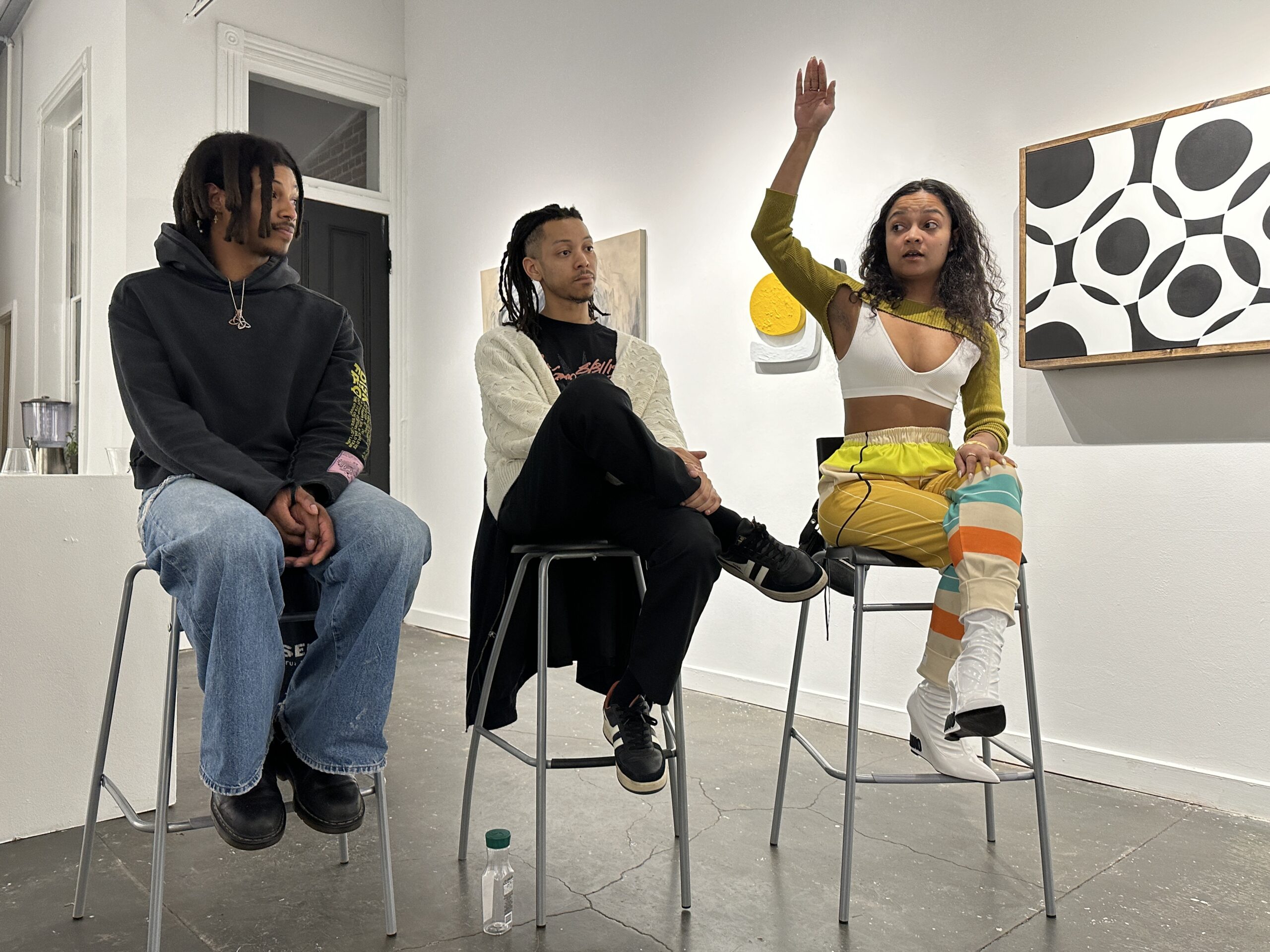
Recently, the Southside Contemporary Art Gallery (SCAG) lined its walls with abstract pieces; each one represented different takes on Black culture. The gallery presented “Black Card Abstracted” as its first exhibit of the year. The exhibit came to a close on March 2, but many pieces are still up for sale.
Thematically, the show focuses on Blackness within an intricate framework, “exploring the multifaceted culture inside and outside of art,” says SCAG partner and exhibit curator Ra-Twoine “Rosetta” Fields.
Fields has had the idea for two years. The title comes from a cultural trope about the giving and taking away of “Black cards,” while the exhibit questions what these represent, he explains.
“It’s pretty much entering into conversation about what it means to be Black, what it means to be a Black artist, what it means to represent Blackness — individually, universally and collectively,” Fields explains. The entire process took about four months, and the exhibit officially opened on Jan. 19.
Fields says that “Black Art Abstracted” takes that cultural trope and engages it within the artistic framework while “focusing more on what it means to be a Black artist and really pulling away from some of the traditionally accepted forms of Black artwork.” He cites more common Black themes such as suffering, struggle and hyper-sexuality.
Instead, Fields likes to create conversations through his exhibits. He encourages attendees to read as much of the artist statements as possible and to attend an upcoming program, bringing their own insight and questions.
Another SCAG partner, Aleyah Grimes, had a solo show she curated at the gallery at the end of 2023. This inspired her to explore more curation and become the curatorial assistant for “Black Card Abstracted.” She organized artwork and did the walkthroughs. Grimes and Fields both wanted the walkthrough to be cohesive visually and narratively.
“It’s all about the multifaceted size of identity and Black culture,” Grimes says. “So I had a hand in arranging the pieces; how even though they’re abstract they have a very strong story, a narrative, and we wanted to make sure they all flowed well together in how they were arranged.”
There was a butterfly by artist Kelly Johnson’s door. As she watched it, Johnson thought it was dying and wanted to take pictures. Suddenly, the butterfly flew away, surprising Johnson and inspiring her. The moment led to Johnson’s painting, “Laughing,” included in the exhibit. “You have to do what you have to do to survive. You can try to stay on what people define as Black life, but it’s an ever-changing world, so we have to adjust,” Johnson explains.

Hampton Roads-native and muralist Dathan Kane is a black-and-white abstract artist whose work is included in the exhibit. “Black and white represent this duality of life, for myself and for those around me. It’s how you respond to the things that take place in your life,” he explains. “Whether it be in a positive or negative way, how can that be displayed via composition?”
Kane painted “Bondage” during a transitional period. He notes that the piece included in this exhibit has three layers of meaning. The painting’s overlapping rings represent the bondage of the oppressed during slavery, he says. They also represent the lack of opportunities and the boundaries present in modern day, when one lacks economic or social status. The third layer of meaning comes from a more personal place for Kane and deals with attachment, or securing bonds with people, and knowing when to break away.
Rain Spann is another featured artist in the exhibit. His usual materials include paper, canvas, oil and acrylic paints, Prismacolor pencils and pastels. Spann makes an effort to reduce his carbon footprint by upcycling paper from other things in his studio, he says. When Spann heard the exhibit’s theme, he saw it as an opportunity for people to expand on who they were beyond the stereotypical idea of what it means to be Black, he says.
He has three works in the exhibit. Two are from a 2022 trilogy titled “When it Strikes,” his abstracted interpretation of the moment when inspiration strikes. The third piece is an ode to Spann’s childhood memories and his roots in Southern culture, he explains, adding that Alabama is his home, but Richmond is his second home.
Detroit-native India Solomon, an abstract visual artist, designer and community developer, has always been in a “maker culture” — from repainting walls to making clothes and jewelry with her mother and paternal grandmother. Solomon started painting professionally four years ago, usually working with acrylic on canvas. However, her work in “Black Card Abstracted” is a new manifestation of her work with 3D sculptural pieces, she says.
“I could not point to a Black woman, specifically, [as a] sculptural artist –at least in my life. I know they exist,” Solomon says, “but it’s not common practice to expect this kind of artwork from people like me.”
She saw this exhibit as an opportunity to showcase her own interpretation of Black art.
“Too often, we are expected to report out on struggle and hardship, and the very real need to portray Black cultural imagery in a white-dominated field has maybe shifted us away from the power of Black abstraction,” Solomon writes. “It’s the stuff of our dreams, not merely our existence.”
SCAG is located at 1309 Hull St. Visit @southsidecontemporary on Instagram for more information.