
Most of the items in the exhibit “Un/Bound: Free Black Virginians 1619 – 1865” can only be described as humble.
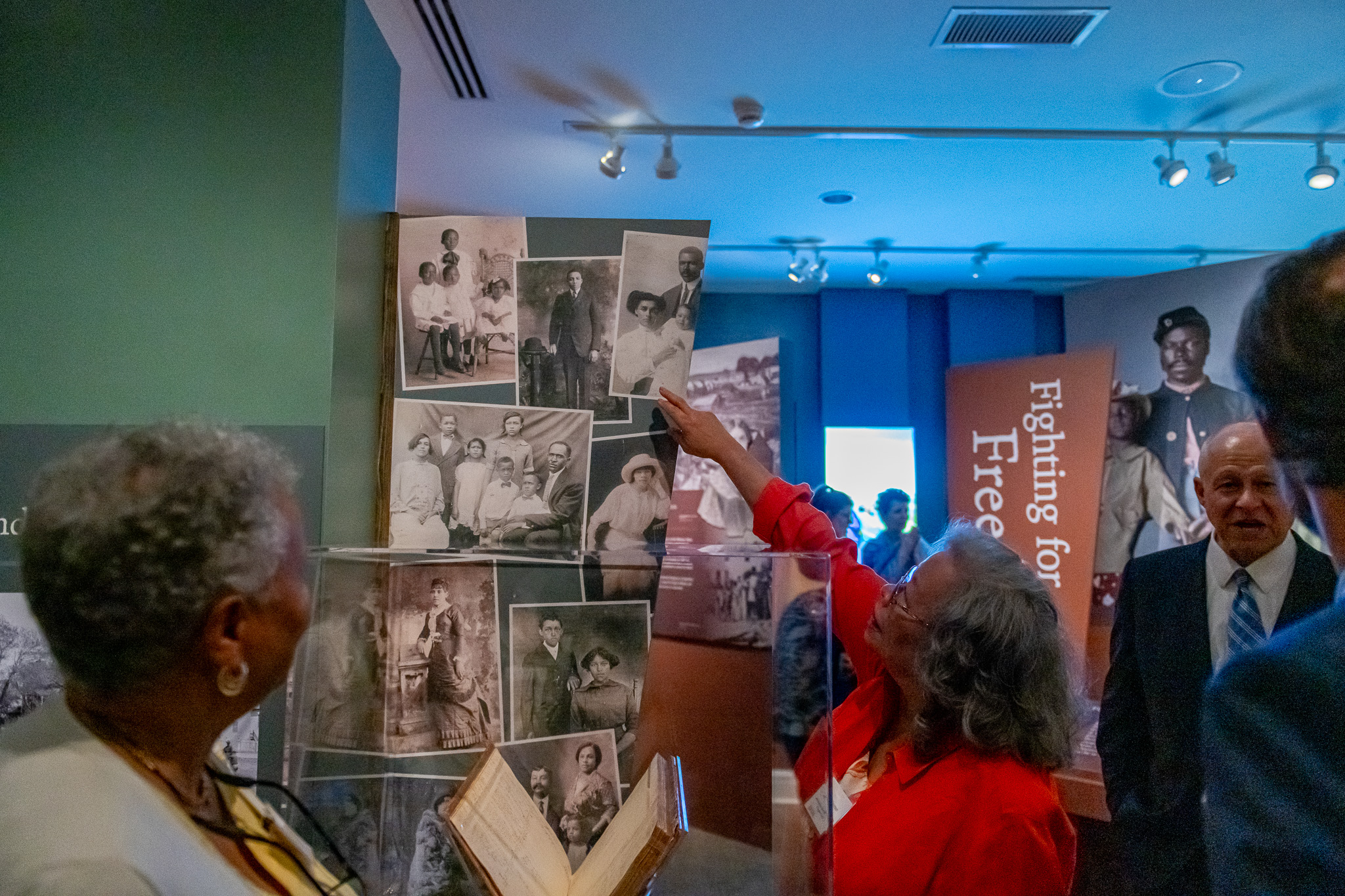
There’s the hammer a free Black shoemaker used, a well-worn trunk passed down in a free family for centuries, and lots of pieces of old brown paper. But, for the man who used it, that hammer was his way of creating wealth. That trunk was the repository for a Black family’s account books, letters, photographs and other items that documented their history.
The old brown pieces of paper —a teenager’s free papers, a pass a free woman used to move around Richmond during the Civil War, a record of a free Black man’s financial transactions— are echoes of what those peoples’ lives were like. “All these small, everyday objects are powerful testaments to the experiences of the people connected to them,” says the curator of the exhibition, Dr. Elizabeth Klaczynski. “They say: We were here, and our stories are important.”

“Un/Bound” at the Virginia Museum of History & Culture tells the stories of free Black Virginians from the arrival of the first captive Africans in 1619 to the abolition of slavery in 1865 when Virginia found itself with 550,000 free Black Virginians. Notably, it is one of the first museum exhibitions to cover the subject in depth.
The history of free Black Virginians has remained largely untold for multiple reasons. Stories of the enslaved were ignored or dismissed for a very long time, until finally historians turned their focus to investigating the institution of slavery and the experiences of the enslaved.
Klaczynski also acknowledges that the existence of free Black people brings up a lot of complicated questions about our state and national history. “They lived in a kind of gray area between enslavement and real freedom,” she explains. “It’s a gray area that forces people to really think hard about what freedom means.”

The legal system that English colonizers carried to Virginia was ambiguous about slavery, with no laws to regulate it. It didn’t take long before colonial authorities created a legal definition of slavery and based it on race. By the mid-1600s, permanent bondage in slavery was the de facto status of most Black people in the colony. But not every Black person.
The exhibit features more than 200 years of stories such as that of Emanuel Driggus, who purchased his freedom and built his fortunes in the late 1600s, prior to codified Virginia laws defining the terms of racial slavery. The Driggus family was part of a small, tight-knit community of free and enslaved Black people living in Northampton County. When his enslaver freed him in 1661, Driggus married a white woman and acquired property. As a respected horse breeder, he leased land from and conducted business with many elite white Virginians.

Artifacts and objects, including state records and testimonials, accompany the stories told in “Un/Bound.” Matthew Ashby’s manumission petition illustrates how a free Black man of modest means convinced the Governor’s Council to permit him to emancipate his wife and children. A needlepoint Sarah Jackson created while attending a Black girls’ school in Maryland in 1860 shows that restrictive literacy laws in Virginia meant that Black students had to travel outside the state to receive an education. That’s a journey that would have been a financial impossibility for most free Black families.
In 2021, Tim Sullivan, former president of William & Mary, and Jim Dyke, former Virginia secretary of education, wrote an article for The Richmond Times-Dispatch calling for support in telling the story of free Black Virginians and “advancing scholarship and promoting public awareness of a unique component of Virginia and American history.” Following this article, the VMHC began to collaborate with Sullivan, Dyke and other subject matter experts and institutions of higher learning, leading to the creation of “Un/Bound.”

Klaczynski found the most challenging part of curating the exhibit to be deciding which stories to include. One that made the cut was that of Virginia-born Joseph Jenkins Roberts, who relocated to Africa with his family in March 1829 to pursue opportunities not available to them in Virginia.
Roberts became the first president of the new nation of Liberia, a place of refuge for many Black Americans seeking to escape discrimination and find opportunities to spread their faith and improve the quality of life for future generations.
“There are so many incredibly rich stories and artifacts to choose from,” says Klaczynski. “I think the most remarkable aspect of this exhibition is in the power of the objects we feature and the stories they help tell.”
“Un/Bound: Free Black Virginians 1619 – 1865” through July 4, 2027 at the Virginia Museum of History and Culture, 428 N. Arthur Ashe Boulevard. Virginiahistory.org