

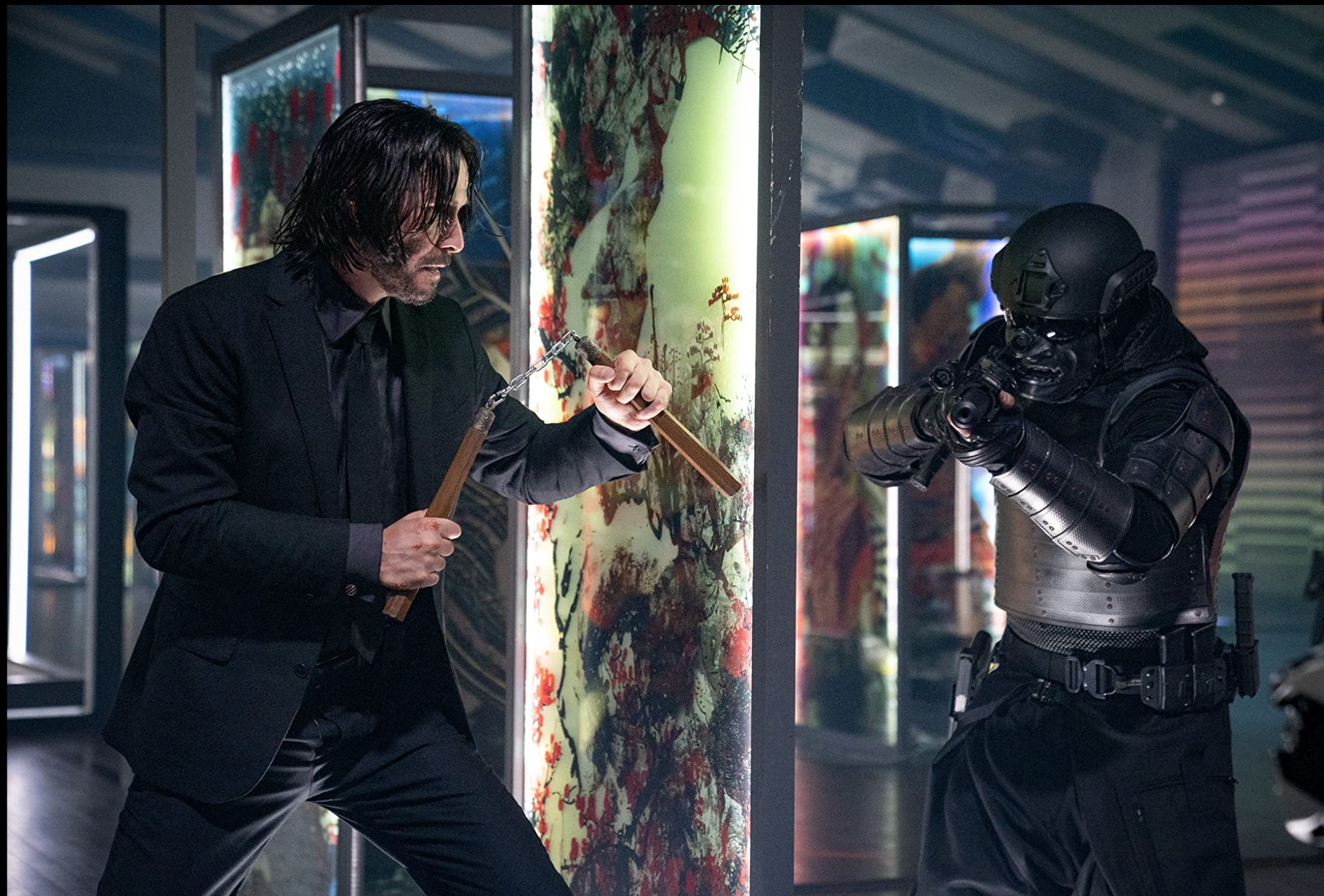
It’s tempting to say that the “John Wick” series has followed a peculiar arc, except that it hasn’t. Anything profitable is eligible for franchising, with attending convoluted “mythology.” Just as the “Fast and the Furious” series began with an unpretentious B-movie 20-some years ago, “John Wick” started out as a slim, unusually stylish revenge yarn. Stereotypical Euro-trash killed a man’s dog and he killed them—the end. The sequels have doubled-down on ruminations over a secret society of aristocratic killers who have their own money pressed from pure gold, their own hotels, and their own medieval pretenses of law-enforcement. Every subsequent movie in the series has more exposition about this society, because “world building” is the game these days. There must be a thread to pull in the name of dozens of sequels and spinoffs.
The “John Wick” mythology is more intriguing than most other franchise machinery for its paranoia. “John Wick” pivots on the idea that this society lives in the most abstract and rarefied of realms, maintaining a royal status quo. This society has eyes everywhere, including the gutters, where a Bowery King played with hearty gusto by Laurence Fishburne has carved out a fiefdom. Society has become so governed by surveillance that refuge is sought in antiquities. Phones can be tracked, but carrier pigeons and telegraph machines can elude detection. Everyone is in on the fix. The first “John Wick” has an amusing joke in which Keanu Reeves’ eponymous assassin kills people loudly in his own home, only to have the police and fire department wave it off with “best wishes.”
This mythology is more important to “John Wick” than say, Vin Diesel’s tortured family dynamics are to “Fast and the Furious.” Diesel’s bro sessions, his insistence on hugging everything out—the bad guys always join his crew—distracts from the reason to see the movies, which is their expensive carnage. “John Wick,” however, needs its mythology to give us permission to enjoy hundreds of people dying for our delectation. Implicitly these killers’ actions affect normal people, as conventional society is run here by the ripple effects of their underground blood orgies, but the killings are always done to people who are in on the game, and the filmmakers accord few of them individuality because they know you don’t care. John Wick’s wife was the last innocent person to die in a “John Wick” movie, and that was from illness three sequels ago. Innocent bystanders dying would break our pact with this series. “John Wick” may push cinematic morality to an edge, but it can’t go “Grand Theft Auto” yet.
The first three “John Wick” movies are torn between conventionality and chaos. They feel an obligation to be normal—to have rudimentary plots and pretenses of humanity—though what they really want to do is go all-in and high-hog on the florid murder choreography that makes the series enjoyable. The first “Mad Max” was similarly hamstrung, until George Miller broke loose with “The Road Warrior” and, much later, “Fury Road.” “John Wick 4” is similarly emboldened. It’s as if director Chad Stahelski and his army of stunt people had breathed a sigh of relief and finally decided to get down with the get down and give us the violent stimulation we want and as much of it as we want all logic and consequences be damned. Foreplay is over; it’s time for sex. And “John Wick 4” is a nearly three-hour orgasm, a shameless and blissfully unpretentious appeal to our collective lizard brain.
The difference between “John Wick 4” and the others is a matter of commitment. Stahelski is concerned with one thing here: mounting a series of action scenes of breathtaking intricacy and fluency. Anything superfluous to that aim is discarded, which gives the film an abstract, coffee-table-book vibe that’s surprisingly appealing. Stahelski’s direction here is so confident that even the world-building is often exciting; people are framed in huge and ornately decadent compositions that suggest the epic tableaux of “Lawrence of Arabia” and “Blade Runner,” among others. That running time doesn’t buy more exposition but more action, as this is two “Wicks” for the price of one.
The plot of “John Wick 4” has been constructed so as to allow for an essay on various subgenres of the action movie. Much of the first third of “John Wick 4” is set in Osaka, so that Stahelski can riff on the tropes of Asian action, particularly that of the gifted ronin who’s forced into a pact to save an innocent. Said ronin is played by Donnie Yen, the legendary “Ip Man” star who finally gets the American centerpiece role that he deserves. As killers rampage the Osaka Continental, the Japanese version of the bad-guy hotel presided over by Ian McShane in New York City, Yen’s Caine awaits the fighting-that-matters to commence, eating noodles in the shadows. It’s a nice, impudent touch, as if Caine has read the script and knows that the center-ring combatants won’t show for a while yet. Yen gives this series a much-needed infusion of humor, and his swagger complements Reeves’ elegant mournfulness. The filmmakers keep coming up with clever bits. One of my favorite involves the blind Caine placing sensors in a kitchen, which are revealed to be laser tripwires that tell him when to shoot someone in the head.
A later section in Berlin allows for the club scenes that have become
something of a trademark in the “John Wick” series. Wick blasts killers in the head to a wicked house beat, and the blood that spurts out could just as easily be confetti or paint. Stahelski, a former stunt man himself, understands that most people don’t go to action movies to satisfy an actual craving for sadism; we go for kinetic movement, for rhythm, for the catharsis of seeing psychological conflicts boiled down to tactile variables. A clichéd comparison holds up: Action movies satisfy the same craving as dance routines, and the gunplay in the “Wick” pictures, especially “4,” is far closer to dance than the action proffered by any other contemporary series.
Stahelski blends the romanticism of Asian action pictures—characters here frequently talk of honor in purplish metaphors, essentially saying that they must kill each other because they love each other— with an American brand of hand-to-hand combat. The fights in these movies are elaborate and weirdly practical, as long, sleek takes capture a process of call and response, of block and block and counter and hit and block again, making spectacles of bodies tumbling into various expensive props against wild and lurid blasts of cinematic color. The gun blasts and the stabbings are like explanation points to the sentences of the physical labor of combat, and Wick and his associates and rivals come to suggest proletarian contractors at the service of a byzantine empire.
“John Wick 4” has been structured so that it keeps topping itself and most every action movie that has preceded it. The shoot-out in the Osaka Continental would be the climax for most movies; here, it’s a palette cleanser. In the last hour, the film relocates to Paris for a series of interlocking action sequences that rate as among the most impressive in cinema. A melee set in a roundabout involves a terrifying number of variables, with killers weaving among speeding cars in a manner that resembles a game of “Frogger.” Later, Wick and Caine battle henchmen on a stairway that suggests a literalizing of the myth of Sisyphus. A final duel, ironically pared down in comparison to all that’s already happened, damn near achieves a kind of invincible-man-of-autumn pathos.
Why does nonsense like “Ant-Man 3” raise my ire while this nonsense nets a rave? One word: style. The action here truly moves—beautifully, fluidly—and the superhuman killers look great and say cool shit. A few more words: an ultraviolent action movie is closer to my personal brand of bullshit than kids and kids-at-heart jumping around in games of PG-rated tag. There’s something cleansing in this film’s honesty about itself as something akin to a kill machine-slash-art expo set in an industrial slaughter house.
“John Wick: Chapter 4” is now in theaters.