
The wildest thing about the ostensible horror movie “Together” is that it expects us to believe that a schoolteacher and an unemployed man who fancies himself a musician can afford to live in a restored cabin somewhere in the woods in the state of Washington. Watching it, I thought back to my days working in a social services agency in a famously beautiful and remote county in Virginia, where many of the schoolteachers had to rent places in a county over and commute.
I’m exhausted with the indifference of modern movies to how people with five-figure incomes actually live. It wasn’t always so. Pop films used to have working-class texture regardless of the fortunes of their creators. I think of the early films of Steven Spielberg, which were intimately in touch with how families lived. Think of the first “Rocky.” I could go on. You get my drift. I assume young millennials or younger, if there are any here reading, are thinking that my sentiments are being piped in from another planet.
“Together” is not a movie about money (to put it lightly) and it has few intentional sociopolitical concerns (to put it even lighter), but these blind contrivances, taken for granted, are telling. In many contemporary movies, the screenwriting is as devoid of texture as the CGI that litters aspiring blockbusters. Our artists (and politicians) are so walled off from us that they don’t even know how to pretend otherwise.
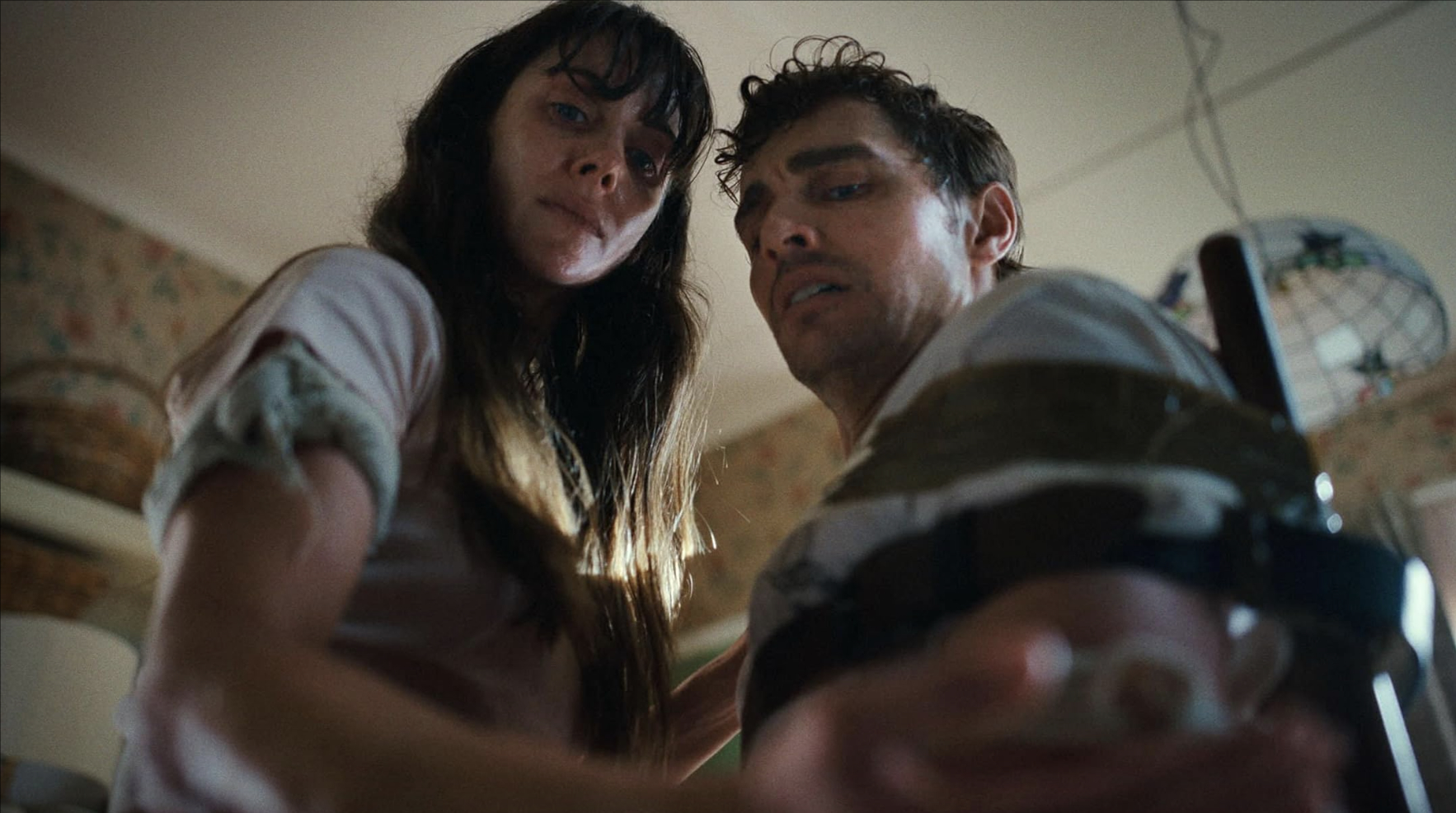
The schoolteacher is Millie (Alison Brie) and the “musician” Tim (Dave Franco). Their relationship is troubled because Tim will not find a real job and, feeling emasculated, cannot be compelled to sleep with the fed-up Millie. Brie and Franco are married in real life, and, when collaborating, are drawn to projects that attempt to circle matters of how money bleeds into the domestic realm. Franco directed two of these collaborations himself: the pretty-good horror movie “The Rental” and the abysmally clueless and privileged romantic dramedy “Somebody I Used to Know.”
“Together” is somewhere in the middle on the Brie-Franco scale, a mild midlife crisis movie with a chaser of body horror. Writer-director Michael Shanks does serviceable work, especially in the first and most atmospheric third of the movie, but the paucity of his imagination grinds one down.
While hiking, Millie and Tim fall into a cave that suggests the interior of a spaceship from an “Alien” movie — think skeletal-vaginal chic. They drink water from the cave and begin to find that their bodies want to conjoin together. The metaphor is blunt and articulated aloud several times: they are a couple of lovers who feel suffocated by the other yet fear they are nothing on their own. Many of us have been there, figuratively.
Shanks wants “Together” to be taken seriously as a relationship movie, and he’s good enough at small details to inspire one to wonder if he and his actors are working through personal stuff. Brie is devastatingly accurate in rendering how women try to pep-talk men they are clearly tired of. It’s an up-talk that’s freighted with disappointment and resignation. Franco isn’t afraid of the fact that Tim is a schmuck. He’s realistically irritating, a Pyrrhic victory that distances you from the movie. Tim and his dumb delusions and Shanks’ typical fantasy-land version of how money works collectively serve to make “Together” feel contrived and insubstantial — straight-to-streaming movie-ish.

You wait in good faith for the body horror to justify your patience with the bougie claptrap. At a certain point, it becomes obvious that Shanks has bet the farm on this relationship storyline, and the horror is virtually an afterthought, a metaphor that’s meant to give “Together” high-minded overtones and little else. Shanks whiffs on promising set-ups over and over again.
Tim and Millie have quick sex in a bathroom stall in the school where Millie teaches — a surprisingly hot moment that is driven by our curiosity as to just how conjoined their parts are going to become. Tim inevitably has difficulty pulling out, but there’s no punchline, and the scene evaporates. When Millie picks up a power tool to cut her and Tim’s enmeshed arms apart, Shanks skimps on the gore yet again. I am reminded of another earnest, promising, bafflingly timid horror movie from early this year: Leigh Whannell’s “Wolf Man.” Say what you will about Coralie Fargeat’s “The Substance,” but she went all the way, squeezing all the pulp that she could from her wild-ass premise.
“Together” is going to leave horror-movie heads feeling cheated. Even the grand climactic flourish, involving of course the fusion of Tim and Millie’s bodies, is paltry and sentimental, invoking the Spice Girls of all things. It’s embarrassing.
An obsessive and claustrophobic relationship, with only one supporting character, that climaxes with the threat of the lovers fusing together. Horror heads will think of David Cronenberg’s 1986 “The Fly,” which blended romance and tragedy and gore and humor together with operatic intensity. That film’s grossness was sublime and touching, the ugliness underscoring a man’s self-loathing. “Together” is similar material, watered down for audiences who… I don’t get. Who is this odd and bland mixture of thriller and romance for? Are folks yearning for Bed, Bath and Body Horror?
There is a book to be written about our current culture’s obsession with mining the past. Hollywood has long prized sequels to hit movies, but this fever has come to feel neurotic. Every week sees the release of something that invites us to escape into another era. There’s hopelessness to this trend, a sense that we are not capable of making things that matter to mass culture now. This hopelessness was the subject of the one masterpiece of the reboot/revival era so far, David Lynch’s third season of “Twin Peaks,” and it was mined potently by Jane Schoenbrum’s “I Saw the TV Glow” as well.
Yes, these thoughts run through my mind even when something like “Happy Gilmore 2” drops on Netflix, a week before a retread of “The Naked Gun” hits theaters. Hollywood is experimenting with bringing comedies back to cinema, and can think of no other way than churning out sequels to touchstones of other eras.
This sadness is built into “Happy Gilmore 2,” which resets Adam Sandler’s famous uncouth, long-driving golfer to a place of poverty, kills off his love interest, makes him an alcoholic, and sticks him with a handful of mostly adult children. The first half hour of “Gilmore 2” is promising for this unexpected bleakness. A few of the jokes land — especially a running bit concerning Happy’s hidden flasks.
The movie is weird, and not only for being yet another pointless nostalgia project. It’s weird because Adam Sandler has grown from an amusing “Saturday Night Live” alumni moonlighting in absurd bro comedies into a terrific actor. I’m not sure there’s an “SNL” actor who has evolved more than Sandler. Bill Murray? He is effective in the right role but narrow in range. Eddie Murphy? His nostalgia sequels are bad even by the nonexistent standards of the genre. Kirsten Wiig? She is an enormously gifted performer who seems to have receded from the spotlight.
Sandler has gone from rage machine (his early hits) to found object in art film (“Punch-Drunk Love”) to the soulful and electric character actor of movies like “The Meyerowitz Stories” and “Uncut Gems.” That doesn’t mean that Sandler isn’t still capable of booking glorified vacations with friends that are released as movies straight to Netflix.
The weirdness of “Happy Gilmore 2” is how it straddles both lines: after that first half hour it becomes baggy and unwatchable junk with a lead star that has far more expressivity and presence than he did in the original, much funnier, much better “Happy Gilmore.” Sandler is older and wiser here, but not even he can go home again.
If you want the pleasure of the new — of that exhilaration when you first watched a movie that you’ve now loved for years — then you need to see something new. You have to break out of your stasis, out of the contemptuous familiar, and take a risk. Break new ground, or double down: That question also plagues the couple of “Together.”
“Together” is in theaters everywhere, and “Happy Gilmore 2” is juicing algorithms at Netflix.