

Row after row, the colorful machines light up as gamblers try their luck.
Boasting names like China Gold, Quick Spin and Queenie, these penny, ten-cent and dollar slot-like machines have their operators entranced; nearly every seat is filled. Over the gamblers’ shoulders you can see how much they have left on their gaming cards on the bottom left of their screens: $20. $200. $1,880.
It’s Friday night at Rosie’s Gaming Emporium in Southside, and everyone is hoping to strike it big. Rosie’s owner, racing and gambling conglomerate Churchill Downs, maintains that this, somehow, is not gambling. Regardless, this “mini casino,” as state legislators have called it, gives Richmonders a taste of what could be in store for the city.
Since the General Assembly passed legislation in 2020 for specified localities to vote on whether to have casinos, four have been approved: Bristol, Danville, Norfolk and Portsmouth. Two years ago, Richmond narrowly voted against allowing Black-owned multimedia conglomerate Urban One to build a casino in an economically depressed area of the city’s Southside.
Now, in partnership with Churchill Downs, Urban One is attempting a second bite at the apple with its proposed $562 million Richmond Grand Resort & Casino (for brevity, the casino developers will be referred to as Urban One in this story). As of Halloween, Urban One was closing in on $10 million in campaign spending, nearly four times the amount spent two years ago.
Proponents say a casino will bring tax revenue and jobs to a part of Richmond that desperately needs them. The city says it will use that revenue to support child care, education, and other initiatives. In both the previous vote and polling from this year, the residents near the casino site have overwhelmingly supported it.
The problem? Some academics say that casinos rarely deliver the tax revenues and jobs that they promise and can lead to a rise in addiction, crime and bankruptcy in the localities they enter. Now, as was the case two years ago, race is playing a significant role in the politics of this decision.
With polls showing that the two sides are neck and neck — and Urban One contending with a late-breaking scandal — what would a casino mean for Richmond?
It’s a warm Friday afternoon at Hickory Hill Community Center in Southside, and Pamela Jones is on her way to vote. A 48-year-old financial adviser, Jones supports the casino and its promises to raise tax revenue and create jobs.
“We need more revenue,” says Jones, a Southside resident. “I’m sick and tired, as being a taxpaying citizen, that every time there’s a shortfall, they come and hit our pocketbooks.”
In addition to the tax revenue a casino would generate, Jones says she’s onboard with the casino’s plan to create a 3,000-seat venue and host a variety of entertainment options.
“I love the Richmond Symphony,” says Jones. “This could be another place for the Richmond Symphony to perform.”
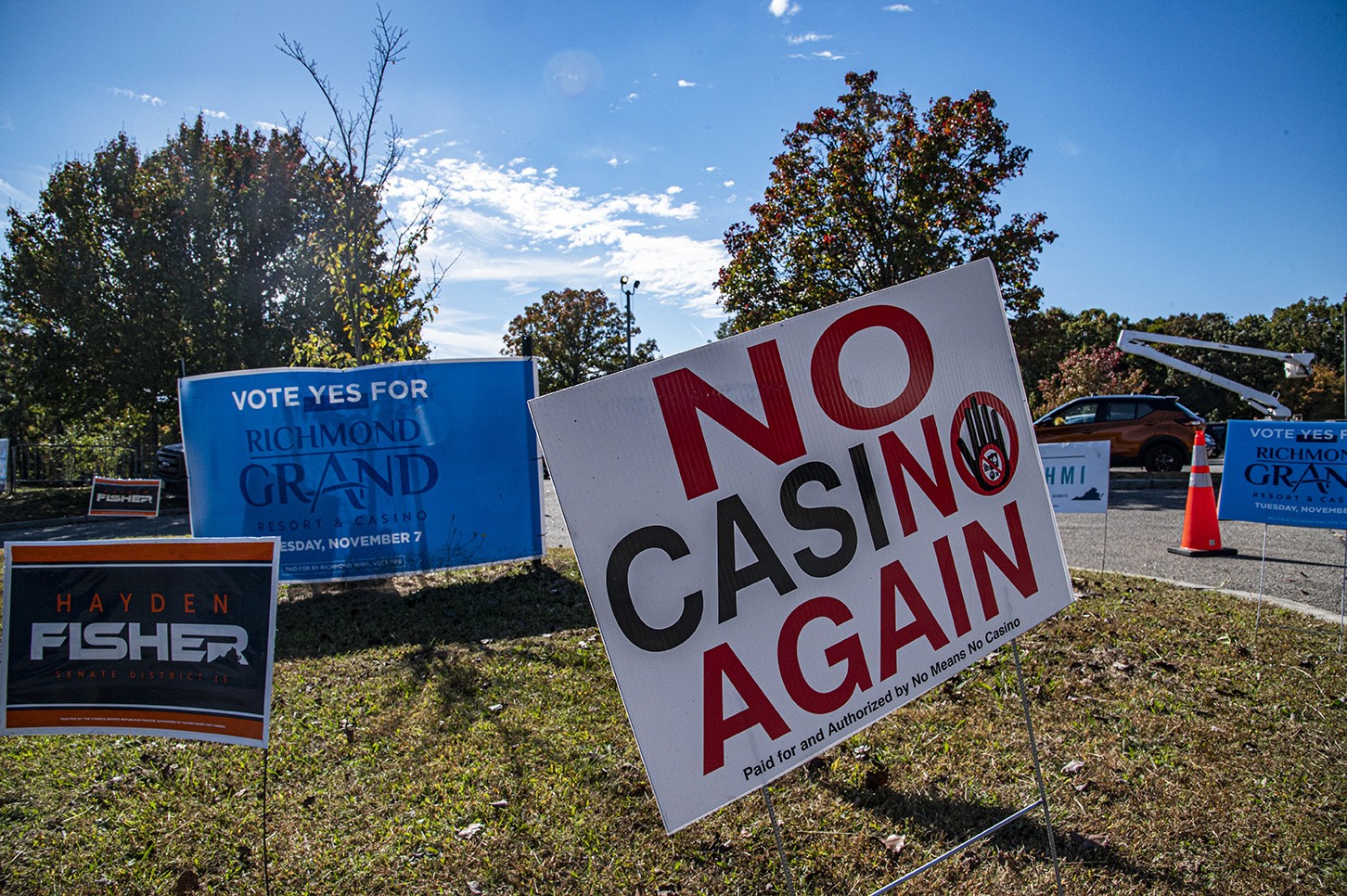
The casino developers are using Hickory Hill, one of Richmond’s three early voting locations, to make a full court press. Anyone who shows up at Hickory Hill during voting hours — regardless of if or how they vote — can get a free meal from a food truck courtesy of Urban One. Last Saturday evening, the community center played host to the Grammy-winning Isley Brothers, paid for by Urban One and free to anyone who got a ticket in time.
Between the food and the Isley Brothers, the message from Urban One is clear: We will bring amenities to Southside Richmond that no one else will.
“We think the Richmond Grand is the right project for the city at the right time,” says Michael Kelly, a spokesman for Urban One and Churchill Downs’ casino campaign. “It is a comprehensive entertainment gaming resort destination that will deliver huge benefits for the entire city.”
[image-6]
If Richmond’s voters approve the casino, the city expects to receive $30 million in annual tax revenue, based on a study by Convergence Strategy Group. Plans include the creation of a 55-acre park, a 250-room luxury hotel and a 3,000-seat concert venue that will bring in national touring acts. The casino will also host 15 dining and beverage options and build a state-of-the-art soundstage for film and television production, committing $50 million to the project over a ten-year period.
There’s also a one-time payment of $26.5 million that the casino developers will give to the city if the referendum vote goes in their favor. In a non-binding resolution, City Council has pledged to spend $14 million of the upfront payment to create new early childhood care centers at T.B. Smith Community Center and Southside Community Center, spend $8 million on parks projects across the city, and allocate $4.5 million to establish the Child Care and Education Trust Fund to expand access to affordable child care and education programs.
Urban One also says that the casino will create 1,300 permanent hospitality jobs with an average compensation of at least $55,000. That figure includes not just wages, but health care, retirement and dental costs. The city’s contract with the developers includes a wage floor of $15 plus tips, which works out to a little above $30,000 a year.
Pressed on what average wages would look like, Kelly reiterated the $55,000 figure, but stressed that it was a baseline and that final wages would be determined after collective bargaining was completed with union representatives. The proposal has collected a number of endorsements, including from organized labor.
Still, there may be some surprises in store.
Josh Stanfield, executive director of volunteer organization Activate Virginia, has raised questions about pollution at the site after looking at the area using mapping and regulatory tools from the Environmental Protection Agency. Pollution could raise the cost and extend the timeline of building a casino here.
“There’s hazardous waste reporting sites,” he says. “There’s dangerous underground pipelines right there. There’s a Superfund site down the street. There’s toxic discharges into both the air and the water from multiple neighbors of the site.”
Asked about potential pollution at the site, Kelly says “initial environmental due diligence has been done and there are no problems.” A request to learn what due diligence had been done at the site wasn’t answered by press time Friday.
And then there’s the fact that Urban One is undergoing the process of delisting by NASDAQ, which can be a sign of financial distress and potential bankruptcy, but could also be because of paperwork violations. In 8-K filings with the SEC, Urban One says it didn’t file required public financial quarterly reports because it found accounting errors related to “non-cash stock based compensation,” as well as its investment in Richmond’s previous casino vote. The filings say the company will file its delinquent reports before its scheduled hearing on Nov. 30.
[image-10]
[image-11]
[image-12]
You sit down at a slot machine and put in a dollar. You pull the lever and the wheels spin. The lights flash and music plays. You’ve won 50 cents!
“I feel like a winner, but I’ve just lost 50 cents,” explains Jonathan Krutz, an emeritus professor at Boise State University who’s studied casinos for three decades. “That’s how slot machines work.”
Krutz is critical of the gambling industry, saying that casinos rarely generate the jobs and additional tax revenue that they promise and lead to issues with addiction and crime. Krutz’s dissertation looked at retail sales and employment over a 15-year period between economies that added casinos and those that didn’t.
“We found very little difference in retail sales growth across the 15-year period, but in 2007 to 2012, during the Great Recession, the casino areas actually did two-to-three times worse in terms of retail sales growth than the non-casino areas,” he says.
In short, Krutz says, casinos don’t boost economies, and in bad times they make things worse.
Convergence Strategy Group’s report says that 22% of the casino’s gambling revenue will come from Richmond residents and 65% will come from the surrounding regional market. Krutz says calling the casino a “resort” is a marketing ploy to make it seem like people will come from elsewhere.
“The money going into the casino is coming out of the local economy, and Richmond is a good example of this,” Krutz says. “Nobody’s going to fly from Nebraska to Richmond to gamble.”
Even if the casino generates expected tax revenues, Krutz says much of this will come from money that would have been spent in Richmond anyway. People who would otherwise have spent their dollars at local restaurants or other entertainment establishments will spend it at the casino instead.
And Lucy Dadayan, a principal research associate with research organization Urban Institute says tax revenues for casinos usually start to decline after just a year or two.
“Every time you open a new casino, it’s going to bring new revenue, but revenue growth is going to wear off over time,” Dadayan says.
Douglas Walker, an economics professor at the College of Charleston in South Carolina, also contends that casino revenue is short-lived, but that it allows politicians to move tax revenues around.
“It gives politicians a way of increasing some revenue without increasing other types of taxes or decreasing spending,” says Walker, who previously studied the impact of what bringing a hypothetical casino to Hampton Roads would mean back in 2015. “At the margin, it’s a political way of politicians getting more money to spend.”
Kelly, the casino campaign spokesman, says that projections of the casino providing $30 million in annual revenue to the city are “fairly conservative.” So far, Virginia’s new casinos in Danville and Bristol have exceeded their revenue expectations.
“We feel confident that the tax revenues will be there,” Kelly says.
Krutz is also critical of casino developers’ job creation projections. If a casino delivers only half the jobs it promised — as recently happened at MGM Springfield in Massachusetts — it’s not as though a locality is going to shut a casino down over the issue.
“These aren’t great jobs,” Krutz adds. “These are jobs sitting there watching people lose their money day after day after day.”
Dadayan agrees with Krutz on these points: “Most of the revenues from casinos are overstated. As for the jobs, yes, they will create jobs, but those jobs are nearly 100% low-skilled jobs.”
For them to make a real dent in a local economy, she says, these jobs would need to be highly skilled. Still, Dadayan says it’s best, from an economic development standpoint, to put a casino in an economically depressed area because it can generate some jobs and economic growth for the surrounding community.
Then there’s the issues of addiction and crime. In a 2019 report evaluating potential casinos in Virginia, the Joint Legislative Audit and Review Commission cited national studies showing that an estimated 5% to 10% of adults may experience gambling problems.
One study found that individuals who live within 10 miles of a casino have a 90% increase in odds of becoming a pathological or problem gambler; 10 miles from the casino site would include practically the entire city.
“Gambling is an addiction-driven activity,” Krutz says. “The slot machines are the revenue product. Some 70% to 80% of a casino’s revenue comes from slot machines. The slot machines make money because they involve betting over and over again very rapidly.”
Some casino advocates compare gambling addiction at a casino to alcoholism at a bar. Krutz says he likes the comparison: At some point, hopefully, a bar will cut someone off and get them an Uber. He contrasts this with the experience of a gambling addict at a casino.
“I go into the casino. I bet all of the money in my wallet. It’s gone,” he says. “I empty my bank account, bet all that money. It’s gone. Go to my retirement savings, bet all that money. It’s gone. Casino says, ‘No problem. Take a cash advance on your credit card.’ There’s no duty of care there.”
In addition to helping fund a gambling addiction hotline through tax revenue, Richmond Grand would pay $200,000 to fund mental health professionals and resources to prevent and treat problem gambling; Krutz says that amount is a drop in the bucket compared to the problems gambling will generate.
There’s also the issue of crime. Krutz cites a study that looked at crimes committed from 1977-1996 that concluded that casinos increased all crimes except murder, and that 8% of property crime and 10% of violent crime in localities with casinos was because of the casino.
Both Urban One and David Forman, vice president of research for the American Gaming Association (AGA), dispute much of the above. To be clear, Krutz, Walker and Dadayan have no stake in whether a casino comes to Richmond; as AGA is a national trade group for the gambling industry, both it and Urban One do.
“Casinos are a big driver of economic activity wherever they come in,” says Forman. “They generate jobs, they generate taxes, and they generate a lot of economic impact, not just at the casino itself.”
Already, Forman says that Virginia’s gambling industry supports more than 8,000 jobs and has created almost $300 million in taxes for the state. Forman says crime studies like the one referenced above are old and don’t reflect the reality of modern casinos. And, he adds, problem gamblers are better served at casinos where staff are trained to recognize gambling addiction, rather than having them gamble virtually at home unchecked.
[image-13]
The day after Style spoke with casino campaign spokesman Michael Kelly, he issued a press release titled “FACT CHECK: Projects Like Richmond Grand Make Communities Safer, Do Not Increase Crime.” Some of the sources in the press release relate to individual states or casinos where impacts might be different than a wider survey.
One section references a news story about MGM Springfield saying that casinos lead to a drop in crime. What the story actually says is that while gun violence had set records in other parts of Springfield, Massachusetts, lately, the area around the casino had maintained a low crime rate because of increased police presence in the area.
AGA states that casino revenues have actually gone up: “On a macro level, there were 1,015 casinos across the country in 2016 that generated $70.15 billion in revenue compared to the 991 casino properties by the end of 2022 that generated $88 billion in brick-and-mortar revenue.” Dadayan says this is “extremely misleading” and that “the casinos that closed largely closed in states where the market was saturated. However, new casinos opened in many other places where the market was not yet saturated. Also, if you adjust $70.15 billion of 2016 to inflation, you will get $86.6 billion.”
Both Urban One and AGA reference a study from the University of Nevada Las Vegas’ International Gaming Institute that says crime numbers may go up with the introduction of a casino, but that the crime rate stays relatively the same in relation to additional people in the area. It recommends higher levels of law enforcement in the area and compares the introduction of a casino as similar to any other recreation or tourism draw.
“Casinos don’t lead to increased local crime rates,” Forman says. “In fact, several analysts actually found decreases in criminal activity in communities following a casino opening.”
Krutz says this is disingenuous because crime increases usually begin three years after a casino opens.
For his part, Walker says that the pros and cons of a casino are often overblown: Localities may see a modest increase in tax revenue and a modest increase in the problems associated with gambling.
“It’s like any other business of a similar size,” he says. “It’s not unique necessarily from other types of businesses like a factory or a mall.”
Like so much else in Richmond politics, race is a major factor in the casino conversation.
Two years ago, Richmond voted 51% to 49% against the casino. Billed as what would have been the nation’s only Black-owned casino and resort, that proposal failed, with voters dividing along racial lines: Black residents largely supported the casino and white residents largely voted against it.
Two out of every three voters in a precinct with a majority white population voted against it. Every precinct in the 8th and 9th districts, which are in Southside and predominantly Black and Latino, strongly supported it.
It looks like we’re about to see these voting patterns repeat. A recent poll conducted by Founders Insight found that 67% of Black poll respondents said they were in favor of the casino; 59% of white poll respondents were against it. Overall, it found a 44% to 44% split with 12% undecided.
For some Black supporters of the casino, the opposition of white residents smacks of paternalism. At an event held by 8th District Councilwoman Reva Trammell in August 2022 at Southside’s Satellite Restaurant and Lounge that Style attended, there was an undercurrent to the pro-casino conversation: This is another opportunity that white Richmonders are trying to take from us.
The Richmond Free Press, the city’s free African American weekly newspaper, supports the casino, citing that 80% of Southside Richmond residents voted in favor of it two years ago.
“The casino proposal is a private sector project with citywide benefits,” the paper wrote. “The half-billion dollar project will be paid for entirely with private money. There are no tax breaks, incentives or tax dollars being used.”
The casino is also supported by the statewide and Richmond branch of the NAACP, as well as the Richmond Crusade for Voters, the oldest Black political group in the Richmond area.
Allan-Charles Chipman, the executive director of Initiatives of Change USA who previously ran for City Council in the 6th District in 2020, is against the casino and says it’s important not to view the racial divide over the casino as a monolithic one: “I’ve never been white a single day in my life,” he says.
As for the casino’s potential impact on Southside, he cites a 2015 study that looked at the impact casinos in Massachusetts had on surrounding Black communities. While some Black respondents lauded the casino for job opportunities it created, others weren’t so positive.
“They had Black people who had gambled who considered it as a trap. Some quoted it as a ‘plantation’ set-up,” says Chipman, who advocates for other ways to achieve the purported benefits of the casino.
[image-9]
Paul Goldman, a Democratic strategist who previously served as chair of the Virginia Democratic Party and as a political adviser to former Gov. Douglas Wilder, founded the No Means No Committee in opposition to the casino. He’s critical of Mayor Levar Stoney’s administration and warns that the casino will impact local politics for decades to come; Style was unsuccessful in its attempts to interview members of Stoney’s administration.
“Stoney and his cronies and his casino moguls will use their casino cash to control the politics of the city for the next generation,” says Goldman, who was recently successful in a lawsuit to get the voter rolls for the casino vote two years ago. “They’ll be able to give huge contributions to everybody running for mayor and council to make sure they get what they want, to make sure they have people who will go to the General Assembly and get what they want.”
Goldman is also critical of the no-bid deal for the casino. Unlike two years ago, Richmond didn’t conduct a public bidding process this time around, leading to an unsuccessful lawsuit by charitable gaming operators.
“It’s probably the single biggest financial scandal in City Hall’s history, giving a no-bid contract to the mayor’s pals that’s worth hundreds of millions of dollars,” Goldman says. “Everybody stands to benefit except the poor and exploited. Who do they think is going to gamble?”
Late this week, Goldman and Chipman found themselves the targets of offensive audio clips that aired on two Urban One-owned radio stations.
In clips from Praise 104.7 FM, Gary Flowers and Urban One founder and board chair Cathy Hughes talk about the casino and call out Chipman and fellow activist Chelsea Higgs Wise. In one of the clips, Hughes calls Black people who oppose the casino “house n—–.” Preston Brown, a guest host on Box 99.5 FM, called Goldman “a Jew who got the same trait as Judas.”
[image-7]
Marsha Landess, regional vice president for Radio One Richmond, confirmed the clips via email, and said that Brown was immediately removed from the show following his remarks.
Landess told Style: “The clips that have been posted online combine more than one show. The majority of the clips are from a morning show on Praise104.7 where the primary voices heard are host Gary Flowers and Cathy Hughes. The clips involving Preston Brown are from a totally separate nighttime show on Box 99.5. He was a guest host on the show and was immediately removed. He and his producer were the only people in the studio for that show. No others.”
She adds: “The anti-Semitic comments heard on The Box, 99.5 were made by a temporary guest host who was not an employee of the station. These statements were horrible and offensive. Once we heard the comments and because he was alone in the studio with his producer, I personally drove to the station and immediately removed him from the show. He will not be appearing again. Our CEO, Alfred Liggins, has personally apologized to Mr. Goldman on behalf of the station and our company, and we again sincerely apologize to Mr. Goldman for these remarks and condemn them in the strongest possible terms.”
[image-8]
There has been no apology for Hughes’ comments. Mayor Levar Stoney, who supports the casino effort, condemned the antisemitic remarks on X, but also left Hughes’ remarks unaddressed. Hughes is Liggins’ mother.
In a statement about the incident, Goldman made reference to his long history with former Gov. Doug Wilder, and said he accepted the apology, but that “the mayor, my friend Alfred, Ms. Hughes, Churchill Downs, the whole pro-casino side seem oblivious to the damage they have done to Richmond.”
Reached by phone Friday, Chipman said “for Cathy Hughes to call me and everyone who’s Black and opposing this casino a house n—– is extremely racist, and it’s demeaning for the people that are doing good work in the city.”
It’s twilight in Southside, and Reva Trammell is standing in the entrance way for the shuttered Philip Morris USA Operations Center Facility at 2001 Walmsley Blvd. It’s here that she hopes Urban One will build Richmond’s casino.
Standing in a sleeveless purple T-shirt that reads “RICHMOND WINS,” the longtime councilwoman of Richmond’s 8th District is exasperated. Raising her voice, she talks about the needs of citizens in this hardscrabble stretch of the city, and how she believes the casino is the only way to address them.
“I’ll never have another chance like this, not ever,” she says. “We don’t have a grocery store. We don’t have a sit-down restaurant.”
From 1979 to 1986, Trammell worked at various Philip Morris locations, including hanging trays of plug tobacco here. She scoffs at the idea of other companies coming to this part of town to fill the employment void.
“Factories are going out of business,” she says. “They’ve downsized. It ain’t no 5,000 people at Philip Morris now. Machines and everything else, computers, it’s taking all of the jobs.”
Young people in the area, she says, don’t have the money to go to college, but they could work hospitality jobs at the casino. It would also provide them with a nice place to eat and drink, to see shows and enjoy a park.
“Our people can’t go to Maymont Park. How are they going to get over there? They could get here,” she says. The casino offers them “a job with benefits. They can put a roof over their head for their children, instead of sleeping in cars.”
She says there’s programs for gambling addiction, and that, as far as crime goes, the casino will have 1,000 cameras on its campus and be much safer than other parts of this industrial area.
In the end, to her, the opposition to the casino comes down to the haves and have-nots.
“You’re hurting us. You got the jobs. You’ve got the nice jobs. You’ve got nice homes. You’ve got money in the bank, money in your pocket,” she says. “Does my people? They’re sleeping in tents over on Bells Road. Can you answer me that one? With moms and children in cars. They want the jobs. They want the jobs.”