
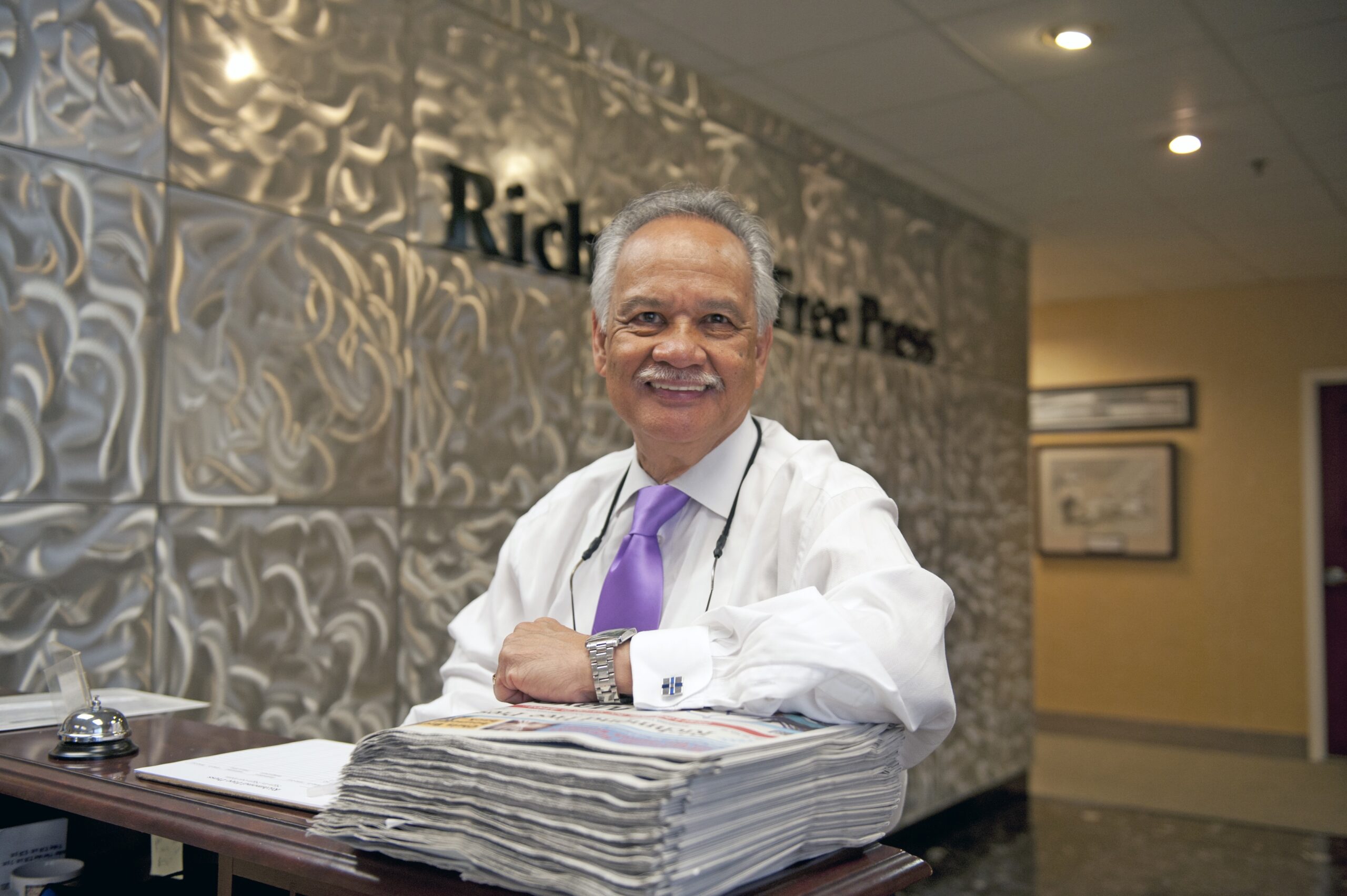
The Richmond Free Press, the city’s African American weekly newspaper, is shutting down after 34 years.
Founded by the late Raymond H. Boone Sr., a crusading editor of the old school variety, the Free Press leaves behind a legacy of giving a voice to the city’s Black population and fighting injustice wherever it found it.
The paper published its first edition on Jan. 16, 1992.
“Richmond desperately needs a strong gust of fresh air to vigorously fan the expression of ideas about public policy and, in the process, to encourage wide-open, uninhibited debate,” Boone wrote in the editorial pages of the paper’s first issue. “Simply put, the mission of the Richmond Free Press is to empower its readers.”
The type of journalism that the Free Press practiced was forged from a long line of Black newspapers that aimed to empower its readers. Boone explained the Free Press’ stance compared to that of mainstream white-owned papers in a Voices of Freedom interview with Virginia Commonwealth University in 2003.
“Newspapers, to a large degree, ignored the principles of journalism, of being fair,” he said. “Instead, they promoted segregation, and they promoted what was popular, rather than honoring the First Amendment, which stands for giving free expression to all segments of the community.”

As the editor of the Richmond Afro-American in the 1960s, Boone fought against Massive Resistance and the bigoted Byrd Machine that dominated state politics. At the time, The Richmond News Leader — the city’s afternoon paper that merged with the Richmond Times-Dispatch in 1992 — was publishing racist columns by James J. Kilpatrick that supported Massive Resistance and were syndicated throughout the South.
In a New York Times article about the shuttering of the News Leader in 1992, Boone weighed in, saying that Richmond’s former afternoon paper had worked to split the city along racial lines. “All of us have suffered,” he said.
Boone once publicly confronted segregationist Gov. Mills Godwin for saying “niggra” instead of “negro,” a known slight that some white politicians practiced.
“I said, ‘Governor, you have been to one of our most prestigious universities. You are a Virginia gentleman, and I know you can articulate and enunciate, and I know you can say ‘hero,’ and you can say ‘zero.’ If you can say those two words, you can say ‘negro,’” Boone later recalled. “Oh my God, they almost fainted. He said, ‘I hear you.’ He never used niggra again to my knowledge. In my presence he didn’t.”
After a decade of editing the Richmond Afro, Boone was named vice president and editor for all newspapers in the Afro-American chain in 1976. He later oversaw the chain’s national circulation while teaching journalism at Howard University.
Returning to Richmond in 1991, Boone wanted to create an alternate publication “for underserved community perspectives, particularly Black Richmonders, while championing free expression, justice and equality,” according to a story about the paper’s closure that the Free Press published Thursday.

Over the years, the paper had many high-profile skirmishes. When then-Mayor Dwight Jones evicted Occupy Richmond from its downtown encampment in 2011, Boone invited the protesters to camp on his front lawn; Jones just happened to be Boone’s next-door neighbor.
In 2013, the Free Press announced it would no longer use the word “Redskins” when referring to the Washington NFL team, saying the term was racist.
“We want to make it absolutely clear that the Richmond Free Press does not endorse or promote that outrageous nickname,” Boone said at the time.
When Ukrop’s outsourced its in-store newspaper distribution in 2006, meaning that Ukrop’s customers would receive the paper a day later than other distribution locations, Boone took out full-page ads and wrote scornful editorials that mocked the grocery chain on First Amendment grounds.
Boone received many accolades for his work, including being inducted into the Virginia Communications Hall of Fame, receiving the Virginia NAACP’s Oliver W. Hill Freedom Fighter Award, the DaimlerChrysler Entrepreneurial Award, and a first-place Virginia Press Association editorial writing award.
The Poynter Institute for Media Studies honored Boone for his “outstanding teaching in journalism.” He was once celebrated for his style of journalism in Black Enterprise magazine. In 1999, Style hailed him as one of the 100 Most Influential Richmonders of the Century; Richmond Magazine named Boone to its list of “100 Power Players” in 1998. In 2018, the block in front of the newspaper’s headquarters at East Franklin and 5th streets was named in his honor.

After Boone’s death on June 3, 2014, Jean Boone, his wife and cofounder of the Free Press, became the paper’s publisher. The Free Press continued to serve its readers, including extensive coverage of the Black Lives Matter protests in the wake of George Floyd’s murder in 2020. For 60 consecutive days and nights, photojournalists Regina H. Boone — Ray and Jean’s daughter — and Sandra Sellers documented the protests and the removal of the city’s Confederate monuments.
Last week, both Jean and Regina Boone spoke with WTVR-6 about their struggles with breast cancer and the need to step away from their careers to heal.

“Thank you for being part of our journey,” wrote Jean Boone in a Facebook post on Thursday. “We know for sure that we do not have the advertising support to continue. The Free Press was founded on the principles of truth-telling, robust debate and giving voice to those who need a champion for their righteous causes.”
Free Press Managing Editor Craig Belcher declined to comment on the closure when Style reached out, referring the reporter to Jean Boone; Jean Boone didn’t respond to Style’s queries by press time Thursday.
“I don’t know that [Ray] thought that we would last this long after his death,” wrote Jean Boone in a Free Press story announcing the closure, “but we kept plugging along and pushing and making a way out of no way.”

Thursday afternoon, Mayor Danny Avula weighed in on the closure of the Free Press.
“It is a sad day in Richmond as one of our core institutions, the Richmond Free Press, is closing its doors,” he wrote. “Many of the advancements we have seen in and around Richmond — in public awareness, in civic consciousness, in conversations about race and equality — did not happen in isolation. They happened because institutions like the Free Press did the steady, disciplined work of publishing stories that others might overlook, documenting injustice, and elevating community voices.
“I am deeply grateful to the founders — the devoted and trailblazing Boone family — the editors, reporters, photographers and staff, who poured their talent and heart into this work. You helped move our city forward. The closing of your doors should inspire us all to remain active and involved neighbors in our communities.
“Thank you for the impact you have had on our city. You will be missed.”
Correction: An earlier version of this story misstated the month that Raymond Boone died, it is June 3, 2014.