

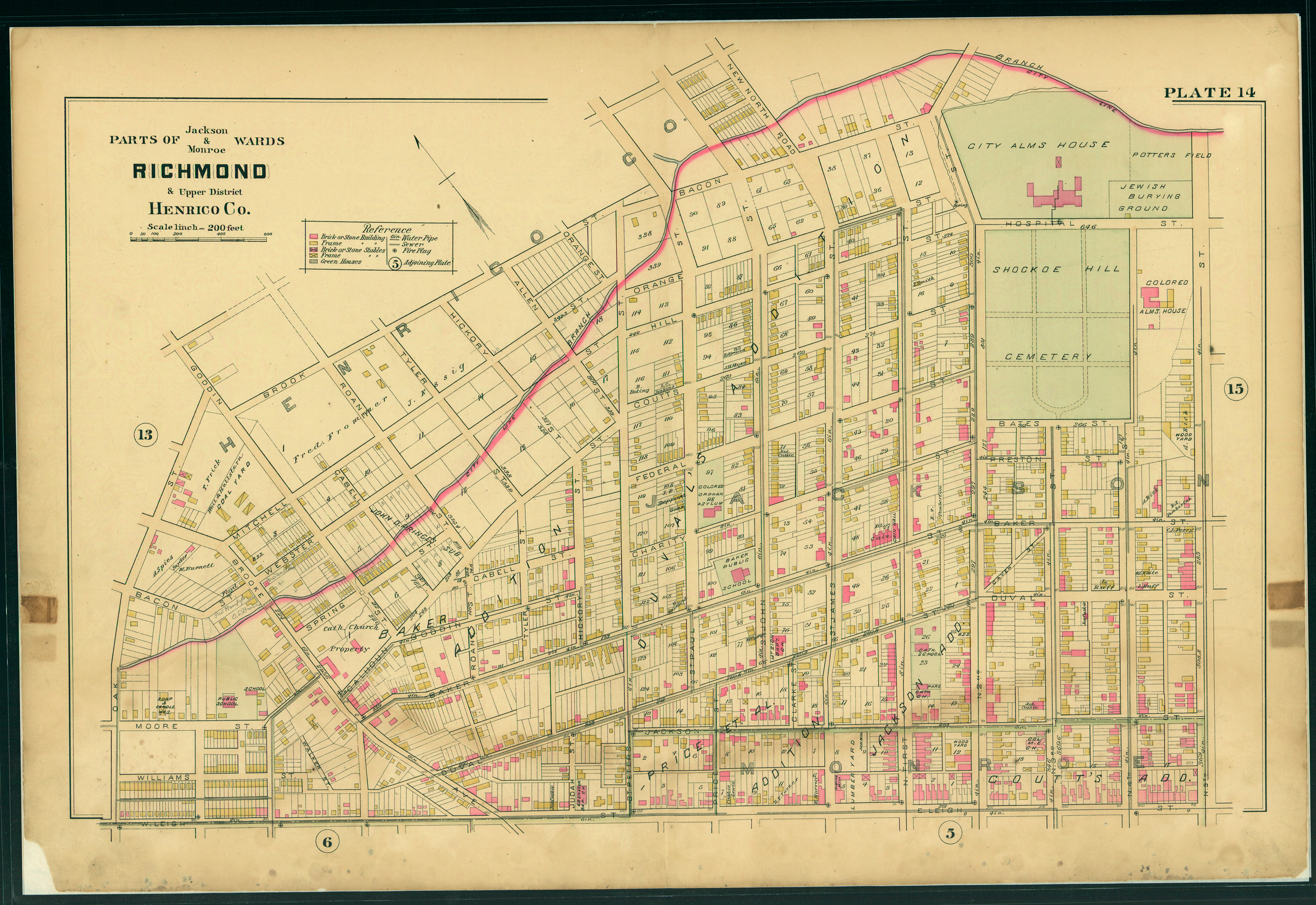
For Sesha Joi Moon, it began with a simple question: Who is the Jackson in Jackson Ward?
“This inquiry led me to the Library of Virginia,” writes Moon, the co-founder of the JXN Project, a historic preservation nonprofit organization dedicated to documenting the history of Jackson Ward, a section of Richmond once known as ‘the Harlem of the South.’ “Little did I know, but those seven words would help to unearth some of the hidden histories of the nation’s first historically registered Black urban neighborhood.”
The results of years of research by Moon, her co-founding sister Enjoli Moon and their JXN Project — working alongside past and present Library of Virginia curators Gregg Kimball, Barbara Batson and others — can be seen in two separate, important projects that will eventually join together. The first, an exhibit called “House to Highway: Reclaiming a Community History,” opens on Monday, July 14 at the Library. Free and open to the public, Moon says that “House to Highway” serves as an opportunity to share the largely untold story of a man named Abraham Peyton Skipwith, who she refers to as “the founding father of Jackson Ward.”

The second project, initiated by JXN with numerous community partners, is set to open next year during Jackson Ward’s Founding Week in April. It’s an accurate recreation of the Skipwith-Roper Cottage, the first known structure erected in what became Jackson Ward, built by Abraham Skipwith. It’s being reconstructed next to a new JXN Haus headquarters at 303 E. Bates Street, on land donated by the Maggie Walker Community Trust and the Richmond Redevelopment and Housing Authority; the original location no longer exists because it is now part of I-95. Once it runs at the Library, the “Houses to Highway” exhibit will eventually be installed inside the cottage.
Moon, the former Chief Diversity Officer of the U.S. House of Representatives who was recently hired as Chief Impact Officer with Girl Scouts of the USA, writes that “JXN’s work is primarily focused on uncovering the origin story of Jackson Ward, with a concentration from 1768 when William Byrd III, son of the man often credited with ‘founding’ the city, first sold parcels of land on the city’s northern edge to 1871, when that same edge was gerrymandered and renamed ‘Jackson Ward.'”
But who was Abraham Peyton Skipwith? According to the exhibit, he was a mixed-race Black man of mysterious origin who was enslaved by Jaquelin Ambler, Thomas Jefferson’s Council of State (who would become Treasurer of the Commonwealth). Somewhere around 1782, he was sold to Thomas Bentley, who signed a manumission expressing that Skipwith be freed when he died. The agreement wasn’t honored by the Virginia General Assembly, however, and Skipwith had to buy his freedom. His petition to the GA has survived and is one of the few documents we have that offer details of his life.

A decade later, Skipwith purchased parcels of land on the northern edge of the City of Richmond for 15 pounds and five shillings in what would become present-day Jackson Ward. “[He would build] a gambrel-roofed cottage known as the Skipwith-Roper Cottage, which is one of the city’s oldest documented dwellings,” Moon writes. “The cottage was a 1.5-story, wood-frame, weatherboard-clad, gambrel-roofed house with a raised basement and single bay Greek revival porch with Doric columns.”
Those are some facts that are known, while others remain elusive. Skipwith clearly had connections and money. But what did he do for a living? “He was a merchant but we don’t know exactly how his business worked,” says Barbara Batson, exhibitions coordinator at the Library. “He accumulates wealth, he buys land… he may have been what they called a ‘factor,’ someone who took orders and then placed the orders with other merchants and sort of acted as a middleman. It’s not entirely clear.”

Race-based urban renewal
What is clear is that this story gives us fresh insight on a largely untold, ultimately shameful chapter in Richmond’s history. “House to Highway” also documents how the Ward was the victim of race-based urban renewal.
“In the late ’50s,” writes Moon, “as part of an interstate highway system that today is known as Interstate 95, Jackson Ward was split in half as Black Richmonders were forcibly removed from their homes and businesses by way of eminent domain.” Around 1957, she says, the cottage was sold by the Richmond-Petersburg Turnpike Authority for approximately $25 and was soon dismantled and displaced for private use on the Sabot Hill Plantation in Goochland county. It still sits there today, repurposed and, unfortunately, renovated to the point that its original fabric no longer exists.
This is why the new recreation of the cottage is important, she says. [It’s] an opportunity to re-erect the structure with greater historical, architectural, cultural, and geographical accuracy, ultimately reestablishing it as a national historic landmark that honors the life, liberty, lineage, and legacy of Abraham Peyton Skipwith.”

Batson says that she and her Library associates have a saying: “We don’t discover, we simply recover.” This story has always been there, she maintains, “but Sesha recovered this tale of the first homeowner or house builder in what later became Jackson Ward. And it’s a fascinating story. He was born enslaved. He petitions for his freedom and has to eventually buy his freedom. He buys his wife and his granddaughter to emancipate them, builds this little house and dies in 1799 leaving an amazing will — I mean, he’s very specific about how he wants his money invested for the benefit of his granddaughter so that she is educated.”
Just as the mostly African-American residents in Jackson Ward had to endure the institutionalized racism of urban renewal, the organizers of the exhibit had to deal with contemporary struggles. The Library of Virginia originally received a $282,975 grant for the exhibition from the National Endowment for the Humanities (NEH), awarded under President Joe Biden’s administration. More than half of that funding was eventually rescinded when the Trump administration came into power. The action was in line with Trump’s Executive Order targeting the National Museum of African American History and Culture in Washington D.C. for being “divisive,” which led to museum director Kevin Young’s resignation earlier this year. According to the nonprofit Human Rights Watch, the directive is “a sign of the administration’s attempts to stifle cultural spaces dedicated to preserving Black history and truths that don’t align with Trump’s political ideology.”
“We got a percentage of the funds, and then after a certain date, we were not able to ask for reimbursement,” says Batson. The exhibit was eventually completed through support from the Community Foundation, Virginia Humanities and WWBT Channel 12.
Who was Jackson Ward named for, anyway?
And what of the original question that started all of this: Who is the Jackson in Jackson Ward?
It’s a long-standing debate that is still in dispute, researchers say, but the name is generally attributed to one of the following: Colonel Giles Beecher Jackson, James Jackson of the Beer Garden (a popular saloon in the early 1800s), President Andrew Jackson or Confederate General Thomas “Stonewall'” Jackson.
“While the first is most deserving of the honor,” writes Moon, “circumstantial evidence suggests that it may in fact have been named after the last.”
It could have been Giles B. Jackson, Batson echoes.
“He was a businessman and a leader in Jackson Ward. I kind of like that idea. But it was probably named after ‘Stonewall’ Jackson. It could also have been [President] Andrew Jackson too, now that I think about it. We just don’t know.”
“House to Highway: Reclaiming a Community History” will open on July 14 at the Library of Virginia. Admission is free. There will be an opening celebration on July 17 at 4 p.m. that features guided tours of the exhibition and a panel discussion with the exhibition team about the origins of the project. For more information, go to https://edu.lva.virginia.gov/house-to-highway/