
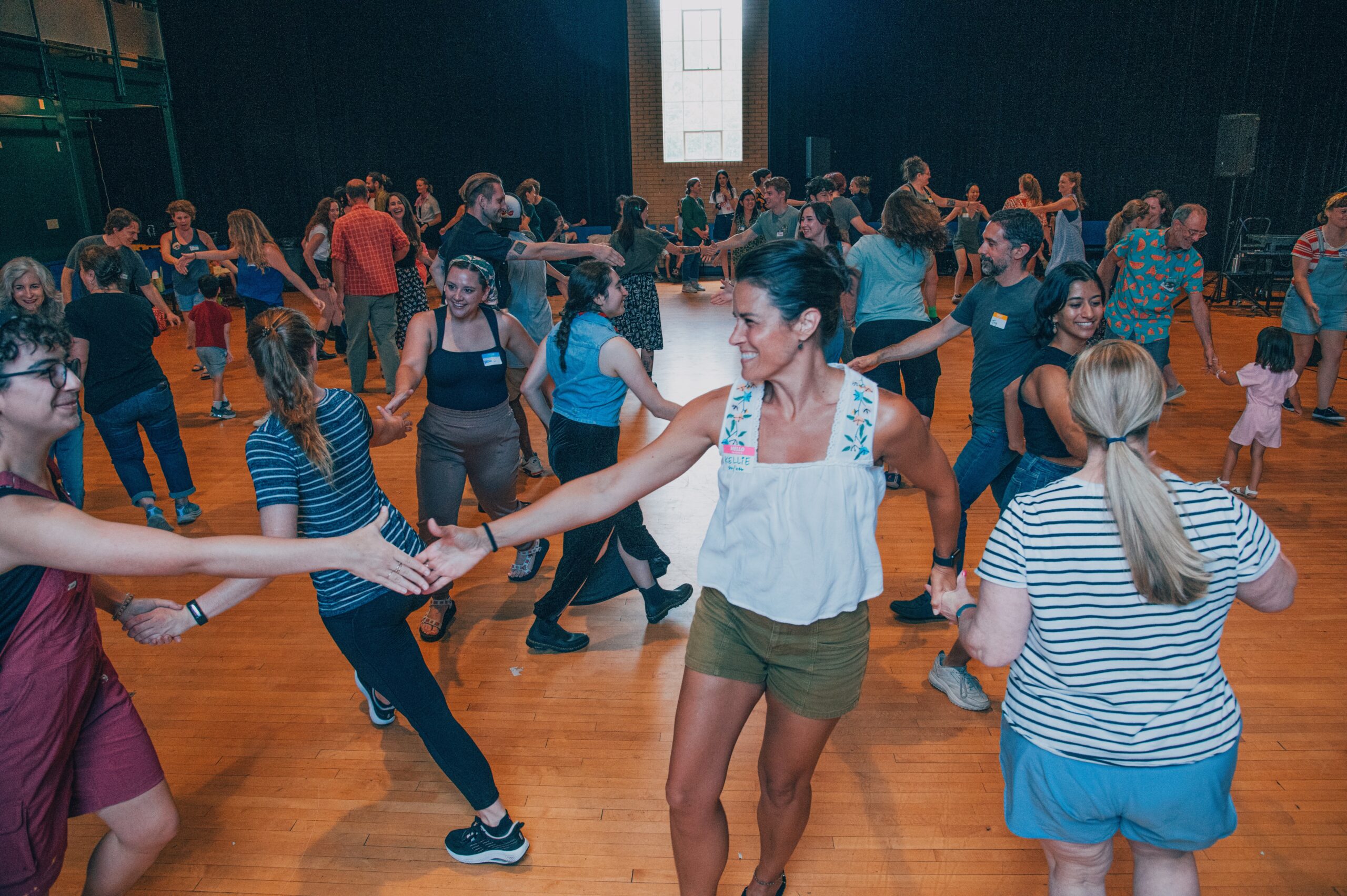
It’s a humid Saturday night in July and the upstairs auditorium at Studio Two Three in Manchester is filled with the sounds of stomping feet and fiddle music.
The group RVA Square Dance — caller Grant Hunnicutt and the Studio Two Three String Band — leads 100 sweaty, arm-locked participants in a series of conjoined dance moves, one of which is called “The Blob.” Dancers lock hands in a circle and begin pulling each other in unorthodox ways, creating a new group shape that constricts, expands and connects with other circles.
Everyone is smiling and having fun. But this is serious business. Tonight’s dance-off is a benefit, with all proceeds going to help Studio Two Three gain back monies lost when, earlier this year, it was denied an already-awarded $200,000 Department of Energy funding grant.
“It was going to do energy efficient improvements on this aged building,” Executive Director Ashley Hawkins announced in March. At press time, the studio had successfully applied for a loan from the Virginia Community Development Fund to help offset the loss “so that our AC doesn’t die on the roof.”
Two Three was also denied a $30,000 National Endowment for the Arts (NEA) grant meant to fund artist residency spaces, one of hundreds denied to arts organizations across the country under the Trump administration’s new directives.
The studio’s response — it had received annual NEA grants the previous five years — has been to take it to the people. The RVA Square Dance exhibition, which raised more than $1,500, is only one in a series of special benefits the Manchester-based arts venue has thrown to offset its federal clawbacks — in March it raised more than $22,000 through a “Sad Prom” event, and in May held a “Dance Party for the End of the World” netting $12,000.
“The dances are wonderful and helped us offset some of the losses,” says Hawkins. “And we had individual donors, anonymously, send us checks immediately following the news that we lost the NEA grant.”
But a lot of that is what she calls “rage giving,” and she notes there’s “about 800 things for people to get enraged about every day under this administration.” How long can this be sustained? “It’s a challenge that arts organizations are going to face. I mean, what happens if the economy does tank with tariffs potentially going into effect? It’s a bit like waiting for the other shoe to drop.”

Fortify for the future
Studio Two Three joins hundreds of arts organizations across the nation in having its NEA arts grants cancelled or rejected; at press time, it’s hard to gauge the number and the monies lost. But arts advocates are alarmed.
“The cancellation of NEA grants, while not unexpected, marks the next step in a deeply troubling pattern of government disinvestment in the arts,” the advocacy group Americans for the Arts reports. “This ongoing pattern of disregard not only threatens vital funding for organizations and communities nationwide — it challenges the very infrastructure that supports cultural expression, economic opportunity and community well-being.”
For Richmond, the effects of federal cuts in arts and culture are going to be seismic, says major philanthropist, Pamela Royall — and long lasting.
“This period is going to set us back for a very long time,” says Royall, the trustee board chair of the Institute for Contemporary Art at VCU. “We need to kind of fortify ourselves for what it’s going to take to move forward. Not just for this [political] cycle, but into the future.”
Several of the region’s most popular cultural amenities, from the Richmond Folk Festival and 1708’s annual InLight installation to historical exhibitions at the Library of Virginia — have or will soon see federal funding disappear. But it goes beyond that: The NEA is just one of the federal cultural funding mechanisms on the chopping block; monies dispensed through the National Endowment of the Humanities (NEH) and The Institute of Museum and Library Services (IMLS) have also been halted or threatened. Trump has signed Executive Orders to eventually do away with all of these agencies.
“If you’re a nonprofit in this region, you are going to be affected. There’s just no way around it,” says Lisa Sims, the executive director of Venture Richmond, sponsor of the Richmond Folk Festival, which typically receives $25-$35,000 a year from the NEA. “Even those organizations who have not depended on the federal government for funds, they might have depended on another foundation or corporate sponsor. And these [entities] only have so much money to give, so it will probably be spread out more thinly because there are so many more organizations who need it.”

Sims and Royall each say that the situation is exacerbated by the fact that federal funding for many other things is being cut as well — basic health services, family food assistance, medical research.
“I work professionally in higher education,” says Royall, who is also the head of research at EAB Enrollment Services, an academic strategic planning agency. “You can imagine the anxiousness, the unsettled nature of people’s day-to-day work. So when we’re considering all of the different appeals that are being made to private philanthropists now to make up for cuts, where does art fall in that list?”
If the funding needed is for something “viewed as a fun thing,” as opposed to children or cancer research, “there’s no doubt what will happen,” Sims says.
“They are going to feed the children first,” echoes Lacey Huszcza, president and CEO of the Richmond Symphony, which typically receives direct NEA funding of $15-$35,000 a year, and even more through sub-grants via the Virginia Commission for the Arts and other sources and foundations.
Recent cuts in city arts funding were even more of a blow to the Symphony, Huszcza says, agreeing that the biggest unknown for organizations like hers is how federal shortfalls will “affect decisions from community foundations or individual donors as they’re choosing where to put their philanthropic dollars.”
In this cycle, the symphony has already lost one NEA grant, a $25,000 stipend awarded to Virginia Opera for the collaborative production of the opera, “Loving v Virginia.”
“That one was pulled on one of the [opening] nights of the shows, which was an interesting moment, I think,” Huszcza says.
Right now, she adds, “it’s hard to know exactly what the direct or indirect effect will be on us. I would say that we are planning cautiously for the future.”

Get creative
Not every affected organization can host hip dance parties or easily tap into casual funders to make up the difference in their loss of federal assistance.
“We have a rotting building, too,” says Shannon Castleman, the founder and director of Oakwood Arts, a Church Hill nonprofit that offers programs, classes and workshops that teach digital and technical skills. “But I stopped the application because I just knew what was going to happen.”
She says when Oakwood first started in 2017, it would host an annual charity ball and auction but soon realized that the expense was prohibitive: “That’s when we made a conscious decision to lean into federal grants.”

After some initial success, Castleman is reeling from Oakwood Arts having two NEA-affiliated grants in peril. Last year, under the Biden administration, it was awarded a $123,500 ArtsHERE grant to expand its Job and Education Training (JET) program, which helps to give underrepresented young adults hands-on training in film production.
“It was such a beautiful grant,” she says. “It’s rare that you have funding that is tied to something that feels like it’s making the world a better place. It was really about expanding access to the arts.” At press time, Oakwood was still waiting to see if a $20,000 NEA Project Grant would be honored. It was able to retain a portion of its ArtsHERE funding.
Some other organizations have been able to appeal or have cancellations rescinded.
“Our last grant was cancelled, but we were able to recover the money,” says Scott Garka, president of CultureWorks, which allocates funding to local arts organizations. “It was a sub-granting grant, which means that the NEA gave us money to award through our grants program to other sub grantees. We got our full $50,000 in the end.”

But CultureWorks decided not to apply for NEA funds in this next grant cycle.
“We didn’t think it was likely to be approved in the current environment,” Garka says. “And I’m concerned about what their terms and conditions would be that we would have to comply with … all these federal regulations and executive orders.” He’s referring largely to the administration’s new focus on funding cultural projects that align with a narrow definition of “patriotic” art coinciding with next year’s 250th anniversary of the Declaration of Independence.
The Library of Virginia, which normally gets grants from NEH as well as the Institute of Museum and Library Services (IMLS), has also had luck in appealing recent funding cuts. But the future is uncertain.
The Library was one of 59 institutions to receive a $172,828 Save America’s Treasures NEH grant through the National Park Service to digitize Virginia legislative petitions dating back to 1776. The Library, a state agency, had the grant rescinded but later reinstated.
Another grant was, weirdly, rescinded but still fully funded, a $315,000 NEH grant to digitize 250,000 separation notices of World War II-era Virginia service members. Another grant of $282,000 to help fund the Library’s current exhibit, “House to Highway,” on the history of Jackson Ward, once known as “the Black Wall Street,” was only partially awarded.
“We had received about $110,000 in funds against an original grant of $282,000, which we paid directly to Riggs Ward, the designers of the exhibit,” says Sarah Falls, the LOV’s chief of researcher development. The Community Foundation came through with local funding in the end.

But one NEH grant was terminated entirely, a two-year $235,692 allotment to digitize 100,000 pages of Virginia newspapers from 1860–1963. “It puts digitized Virginia newspapers into not only the Library of Congress’s collection chronicling America,” she says, “but also in our Virginia Chronicle collection. That’s a longstanding resource that is incredibly important to lots of different researchers from genealogy to Virginia history.”
Falls worries about future IMLS funding for all of the different research databases that the Library of Virginia maintains and updates, from ancestry records to its index of marriage, birth and death records. “Some of these also pipeline into our public school systems, and that’s a major loss to public education in Virginia.”
Is there hope for alternate funding? “We don’t know yet,” she says. “We’re a larger state institution, so we can certainly continue to move forward. But these kinds of bigger grants allow us to digitize content in this upcoming world of AI and to really move forward in new ways.” She sighs. “This is going to be a setback.”

The loss of NEH grant funding is also impacting the Children’s Museum of Richmond, which had been awarded a three-year, $188,000 grant for its school readiness program. “In total, we received just under $18,000 of the first year of the award,” says Danielle Ripperton, executive director of CMoR. “But then the remaining to date has been canceled. We’ve applied for an appeal.”
The museum was able to finish out the initiative’s first year. “We know that kids aren’t ready for kindergarten, so we can’t stop the program.”
In the future, she adds, the museum, eyeing corporate sponsorships and foundation grants, will be treating the government like any other fickle funder. “Things change all the time in nonprofit worlds with funders who traditionally support a program and then don’t. That happens. I think it’s important for all organizations to diversify their funding streams. This is a good reminder … [to] not put all our eggs in one basket.”

Creative thinking
“The ICA’s current budget and operations aren’t directly impacted by the changing federal funding landscape”
That’s the official statement from Virginia Commonwealth University about how a loss of NEA funding will affect its School of the Arts-affiliated modern art museum. But the ICA’s new director says no one in Richmond’s arts community will be exempt from impacts.
“This climate is affecting everyone,” says Jessica Bell Brown. “Even if we have historically received very little funding at the federal level, we have to be thinking about our future. If one cultural institution in our city is feeling it, that means we’re all feeling it. We’re all in one interdependent ecology here.”
Responding to the crisis, the ICA threw a “Full House” in late August, inviting more than 25 local arts groups to meet at the museum and talk about how to navigate the federal landscape. Castleman at Oakwood Arts is planning another summit on Sept. 11 for some of the city’s smaller nonprofit organizations, not just those in the arts.
These meetings are a recognition that collaboration and creative fundraising are going to be integral to survival. “That has been a part of our strategy at the symphony for a few years,” says Huszcza. “It is becoming more imperative now. It will be about how we’re collaborating, what we’re programming, and how we’re getting that message out.”
Emily Smith, executive director at 1708 Gallery, says that arts donors are going to need to step up. “For folks who care about supporting artists and supporting the arts community in Richmond, now is the time to get involved. If you already support an organization, really listen to what’s coming out of that organization and figure out how to help them.”

1708 Gallery’s annual InLight exhibition has been a Richmond mainstay for 17 years, a showcase of light-based media and interactive art that is installed in a different city locale every November. InLight has received NEA grants for the past dozen years, in amounts fluctuating between $35-$50,000. But that has come to an end.
It’s time for Plan B, Smith says. “We are reaching out to past supporters of InLight, reaching out to individuals to help broaden that base of support and connect with some previous corporate supporters, just to close that gap,” she explains.
Smith estimates that the Richmond arts community will lose in the neighborhood of $300,000 in NEA funding this year, and that includes sub-granting through the Virginia Commission for the Arts, whose future remains uncertain. Using NEA funds, the VCA typically allocates funding to 25 Virginia arts organizations in awards ranging from $10,000 to $45,000. (Along with officials from the NEA, Colleen Messick, the executive director of the Virginia Commission for the Arts, did not respond to interview requests.)
While many arts groups may see short-term bumps in donations, the million-dollar question is how will they sustain themselves moving forward. Many were just dealing with reduced attendance numbers since the COVID pandemic; and let’s not forget the city’s tourism and small business dollars could suffer along with them.
In a 2022 study commissioned by CultureWorks, Richmond’s arts and culture sector generated $329.9 million in economic activity — $213.2 million in spending by arts organizations and an additional $116.7 million in event-related expenditures by audiences.
Smith says that 1708 has seen new donors, thanks to a direct appeal that references the NEA shortfall. In July, it announced a contest where three rare prints by Shepard Fairey — the artist behind the iconic Barack Obama “Hope” poster — were dangled as prizes to those who donate and help offset the NEA loss.
“Those are posters from my collection,” says Pamela Royall. “It was Emily’s idea, but I told her, if you can make some money selling these, go ahead.” It’s an example, Royall adds, of alternate ways that donors can support organizations. “In this case, it’s a contribution of the artwork rather than a direct cash contribution.”
A constant refrain from arts and culture leaders is that, to survive this new landscape, organizations are going to have to join forces and collaborate as never before — to form a sort-of figurative “blob.” They’ll need to think and move in new ways and be willing to join hands in a circle and push and pull each other in order to connect with themselves and others in new ways.
It has to happen, Huszcza says.
“This is one of those times where we really determine what the power of the arts is for us and how it matters in our community. We have to make choices about where we stand and how we can make sure that what we have in Richmond isn’t lost. But it will take time and definitely collaboration, creative thinking, and still more community building, because none of us can do it alone.”