

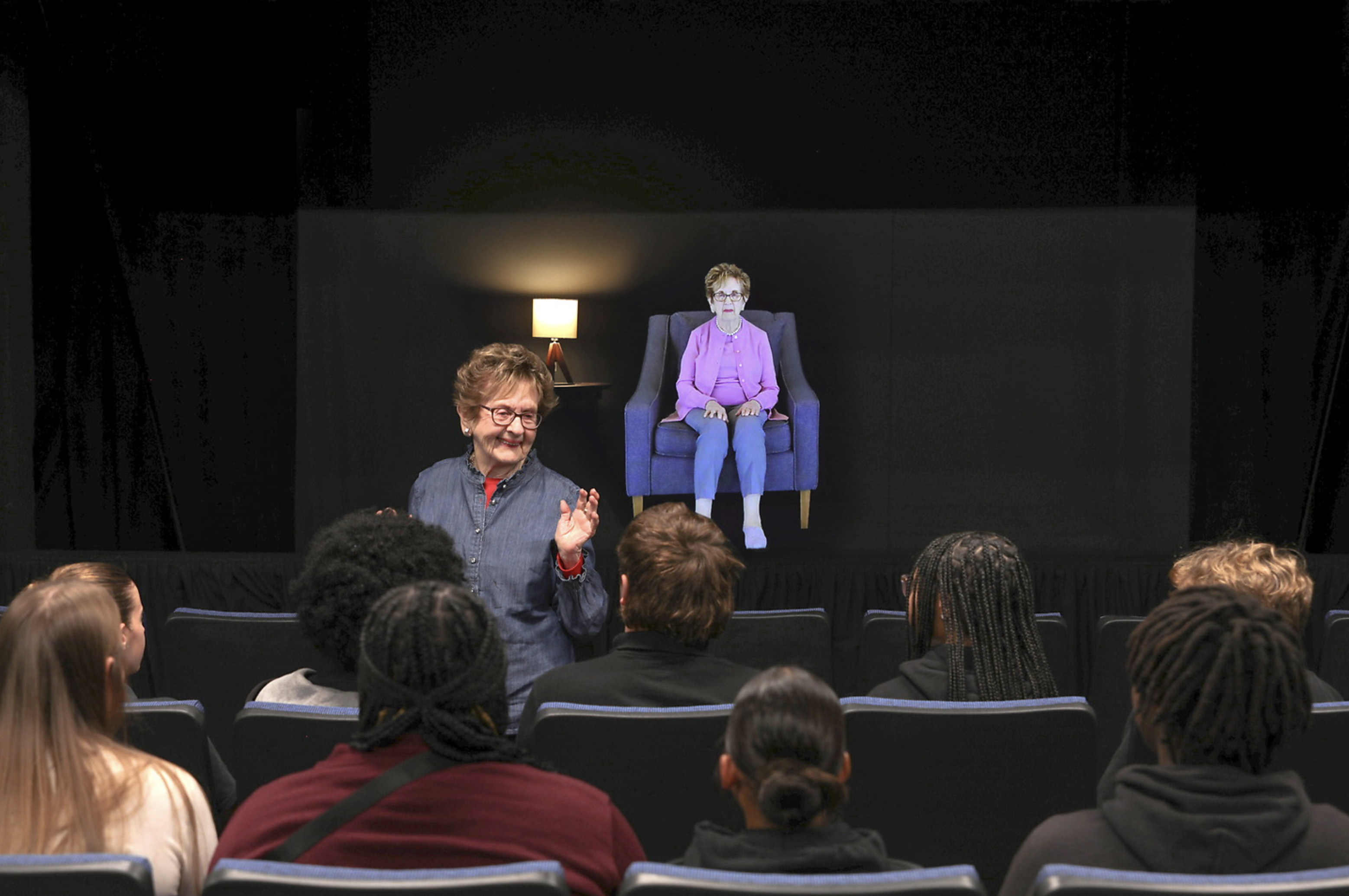
“Dimensions in Testimony,” the new attraction at the Virginia Holocaust Museum, is a technological marvel. But it’s more than that, says Samuel Asher, the president and executive director of the Richmond museum. It’s a new way to remember.
The exhibit opens on Nov. 1 in the museum’s new 46-seat Alan and Halina Zimm Theater of Remembrance, which was built specifically to feature the unusual interactive display. The VHM is one of four institutions nationwide to use this groundbreaking technology developed by the Shoah Foundation, a nonprofit organization based at the University of Southern California. In their mission statement, the foundation says that it is “dedicated to making audio-visual interviews with survivors and witnesses of the Holocaust as a compelling voice for research, education and action.”
Style Weekly recently spoke with Samuel Asher about the new permanent exhibit, how it works, and its relevance to the national moment.
Style Weekly: How would you describe the technology behind “Dimensions in Testimony”?
Samuel Asher: These are interactive survivor biographers that enable people to ask direct questions of holocaust survivors and other witnesses to the genocide, and to receive responses from pre-recorded video images in interviews
When you say ‘interactive,’ what does that mean?
You can talk to the image and the image talks back. It’s the greatest AI for us because, as you know, the Virginia Holocaust Museum is charged with the responsibility of preserving and documenting the Holocaust in our community.
Will all of the museums currently showcasing this technology feature the same interviewees, or are they different?
Our first featured subject is Halina Zimm [a witness to the Warsaw Ghetto and a Polish resistance leader] because she is from here and we are the only one to have her. The exhibit will change once a month and we have five different subjects that we will cycle through several times… basically four survivors and a liberator who freed one of the camps. Halina is a Virginia survivor, and the others are from Toronto, Chicago and Indiana. The liberator is from New Jersey. I’m worried that we are fast approaching a time when these folks won’t be here anymore, and that’s why this technology is so important. [Note: Two of the interviewees have already passed.]

The theatre is also named after Halina Zimm and her husband, Alan. I’m told it was built specifically to the specifications of this exhibit.
Yes, all thanks to our donors. It’s a big price tag, roughly half a million dollars. Halina herself has a tremendous draw. She’s spoken to so many student groups, there’s one high school she’s been to ten different times. So they know it’s her. When a group of students recently tried it out, their response was, ‘Wow, it was great to talk with Halina,’ as if she was there.
What is the process behind the new technology?
People ask, did you invent the answers? No, Halina was asked questions and filmed giving answers for five days, six hours a day, with ten cameras running simultaneously by the Shoah Foundation. You see, a computer doesn’t develop anything. It is just taking answers that it has from Halina and putting them out when the question is asked.
What happens if someone asks a question that she or one of the other subjects didn’t address?
In the rare case when that happens, the AI will simply say, ‘I don’t understand the question,’ just like you were talking to a person.
Will this program expand in the future beyond the initial five interviewees?
It’s possible. We license from the Shoah Foundation so you’d have to ask them. If they choose to do a program on Rwanda or Cambodia or other genocides, we’re all in. It’s up to them to put it together.

“Dimensions in Testimony” is opening at a time when one of the presidential candidates is said to emulate Hitler and has been called a fascist. Can you divorce this from the historical work you do at the museum?
I think the importance of Holocaust museums in general has gone up a number of levels. Because if we don’t learn from history, we are doomed to repeat it. Steven Spielberg said recently that individual hate is a terrible thing, but when collective hate organizes and gets industrialized then genocide follows. We know anti-semitism is on the rise and we know what happened in Pittsburgh [where a gunman killed several people in a synagogue in 2018] and other places and we need to be prepared to stand against it.
Has the Virginia Holocaust Museum received any blowback, from donors or patrons, from Israel’s recent conflicts with Palestinians?
We haven’t had anything like that, and I think that’s because people know that we are neutral territory. We are teaching history and we want people to know what happened during that terrible time in the world’s history when millions of people were killed.
What do you hope people will take away from Dimensions in Testimony?
That it’s important that we remember. During the war, Dwight D. Eisenhower, the general in charge of the Allied Troops, stood at Ohrdruf concentration camp [in 1945] and he called for every photographer in the allied forces to come and take pictures. He said, and I’m paraphrasing, that some day some sick son of a gun will say it didn’t happen. It’s our job to make sure everyone knows that it did happen. And that when it starts with hate, it can grow to something out of control that can cause millions of deaths. So we have to know it can happen. And Halina Zimm herself will tell you that love is much more important than hate. There’s much more hate out there now than any time in my lifetime and we need to be proactive in standing up against it.
“Dimensions in Testimony” from the USC Shoah Foundation opens at the Virginia Holocaust Museum on Nov. 1. Museum admission is free but showtimes for the exhibit are limited and reservations must be made online at vaholocaust.org.