
Alex Nyerges has been here before.
When the director and chief executive officer of the Virginia Museum of Fine Arts arrived at his post in 2006, the public institution was just beginning work on the James W. and Frances Gibson McGlothlin Wing that would open in 2010. The museum was supposed to stay open during the major expansion, but Nyerges says that proved impossible.
“We started construction as I was starting the job, but the design was already done,” explains Nyerges in a July interview for this story. “By the time we got to 2007/2008 and the building was going up, it became pretty apparent there was no way we could stay open for safety reasons alone.”
The museum was closed for 10 months, reopening to fanfare in May 2010 with the addition of the $150 million, 165,000-square-foot McGlothlin Wing.
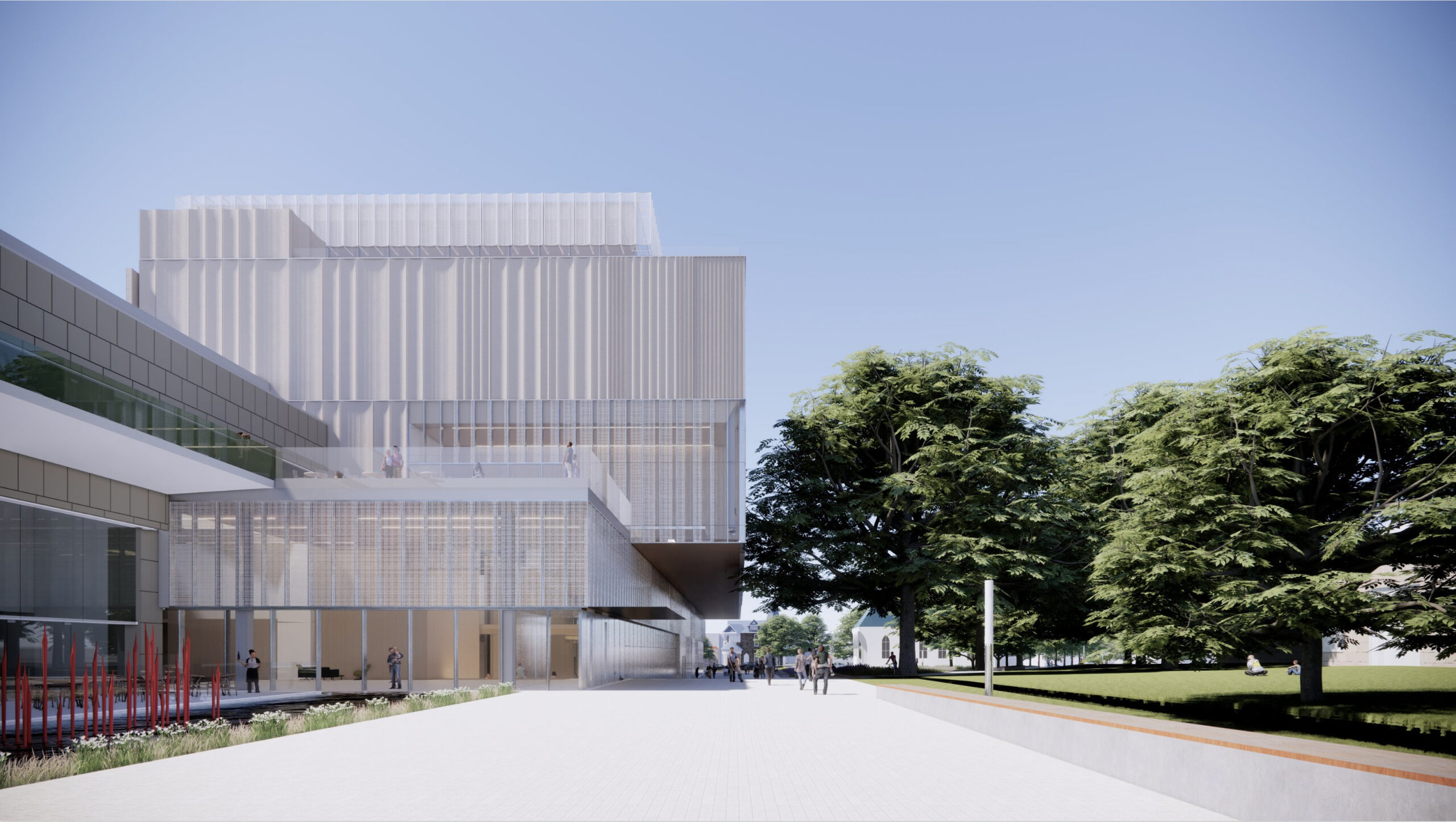
Now, the VMFA is undertaking another major expansion. The upcoming five-story McGlothlin II Wing will be added to the southwestern corner of the current museum, brushing up against and overhanging part of the current sidewalk that runs between Grove Avenue and the E. Claiborne and Lora Robins Sculpture Garden.
During this $261 million expansion, the VMFA again plans to stay open.
“This is the largest expansion in our history: 173,000 square feet, plus we’re also renovating 45,000 square feet [of the current museum],” Nyerges says. “When you add those two together, you’re talking about nearly a quarter million square feet between renovation and expansion, so it’s by far the largest that we’ve ever done. It will also push us to just about 825,000 square feet under roof, which will put us at about the fifth largest art museum in the United States, as far as space.”
Site prep for the expansion will begin this fall, with groundbreaking scheduled for spring 2026; completion is expected in late 2028. International architecture firm SmithGroup is designing the addition, which will feature an exterior of glass and fluted pre-cast concrete.
The upcoming expansion and the previous one bear the names of the McGlothlins — two of the state’s biggest philanthropists — who donated hundreds of millions in funds and art to the VMFA. Jim McGlothlin, a coal magnate who branched into other ventures like real estate and oil, died on Aug. 6 of this year at the age of 85. McGlothlin was instrumental in the effort to legalize commercial casinos in Virginia and cofounded the Hard Rock Hotel & Casino Bristol, the state’s first casino. He was also in the news in the mid-2000s for threatening to withhold a $12 million pledge to William and Mary over the Wren Chapel cross controversy, which partially led to the resignation of then-university president Gene Nichol.

Last December, plans for the upcoming VMFA expansion ran into a snag when the state Art and Architectural Review Board rejected the design proposal; the expansion was approved 4-0 this January with one abstention. “The board that met in December, most of them were new board members,” explains Nyerges of their change of heart. “They hadn’t been at the first hearing, which was in the spring of ’24. They were unfamiliar with the project. It wasn’t a qualitative response to the project itself; they were just not ready to vote.”
Multiple attempts to contact AARB to corroborate Nyerges’ account were unsuccessful. The Virginia Department of General Services, which provides administrative support to the board, declined to comment on Nyerges’ statement.
The upcoming expansion will allow the museum to showcase thousands of additional works at a time, Nyerges says. Already, the museum’s African art galleries, Indigenous American art galleries, pre-Columbian art galleries, and the Lewis Galleries of art deco, art nouveau, and mid-to-late 20th-century art have been closed in anticipation of construction.
The museum’s African art will be reinstalled in the future expansion’s first floor.
“We will have 8,500 square feet of gallery space for African art, which is the most of any art museum with dedicated African space except for the Smithsonian’s National Museum of African Art up in Washington,” Nyerges says.

The expansion’s first floor will also see a new bistro open in the southwest corner of the building facing Grove Avenue. The bistro will serve lighter fare positioned somewhere between the museum’s upscale restaurant Amuse and its cafeteria-like Best Café on the ground floor.
The second floor of the addition will host the museum’s German Expressionism works, doubling the collection’s footprint at the museum, and house office space for staff. The third floor of the addition will include an outdoor terrace with views of the garden and dedicate nearly 30,000 square feet to American art.
“That’s the fourth largest space dedicated to American art anywhere,” Nyerges says. “We have so many great works of art in storage. The McGlothlins* are actually giving us more works of art as well. It’s going to be a massive amount of American art.”
The fourth floor addition will roughly quadruple the amount of museum space dedicated to contemporary art and create a second space for major special exhibitions like the current Frida Kahlo-focused “Kahlo: Beyond the Myth” in the basement-level Altria Group Gallery and NewMarket Gallery.
“It’s the exact same sized space, but this one’s going to be up on the fourth floor of the building,” Nyerges explains. “We’re going to always have a major special exhibition on view. About 60% of the time, we’re going to have two [exhibitions at the same time].”
The fifth floor will host a special event space.
“It will be able to sit 500 people for a lunch or a dinner event,” Nyerges says. “It has outdoor terraces on the north and west and the south sides of the building. On the south end of that floor is going to be a suite of meeting rooms and a large board room with all the latest technology, and those will have terraces outside them as well.”
In the existing museum, the former African art galleries and small special exhibition space known as the Evans Court Gallery will be repurposed for European art, allowing the museum the ability to tell the history of European art seamlessly.
The existing second floor will host the Raysor Center for Works on Paper and the Paper Conservation Studios. Named for Frank Raysor, the late business executive and art collector who donated more than 10,000 prints to the VMFA, the Raysor Center will hold all the museum’s works on paper: watercolors, drawings, prints and photography. The current American art galleries on the second floor will be repurposed to showcase photography.
“Those galleries will constitute the fourth-largest space dedicated to photography in any major art museum in the United States,” Nyerges says.
This spring, the VMFA finished a major $6.2 million renovation of the Leslie Cheek Theater that included the widening of the opening for the stage, new technology throughout, and new seats, ceilings and surfaces. The theater is now home to Richmond Ballet’s Moving Art Series.
Nyerges says the museum is closing in on raising the final $100 million of its ongoing $471 million capital campaign, adding that the effort is the largest fundraising campaign for a cultural institution in Virginia history.
Growth seems to be in the cards. When the first McGlothin Wing opened in 2010, the museum held 20,000 works of art; it now has more than 50,000.
“Build it,” Nyerges says, “and they will give.” 6
* – Jim McGlothlin was still alive at the time of Style’s interview with Alex Nyerges in July.