

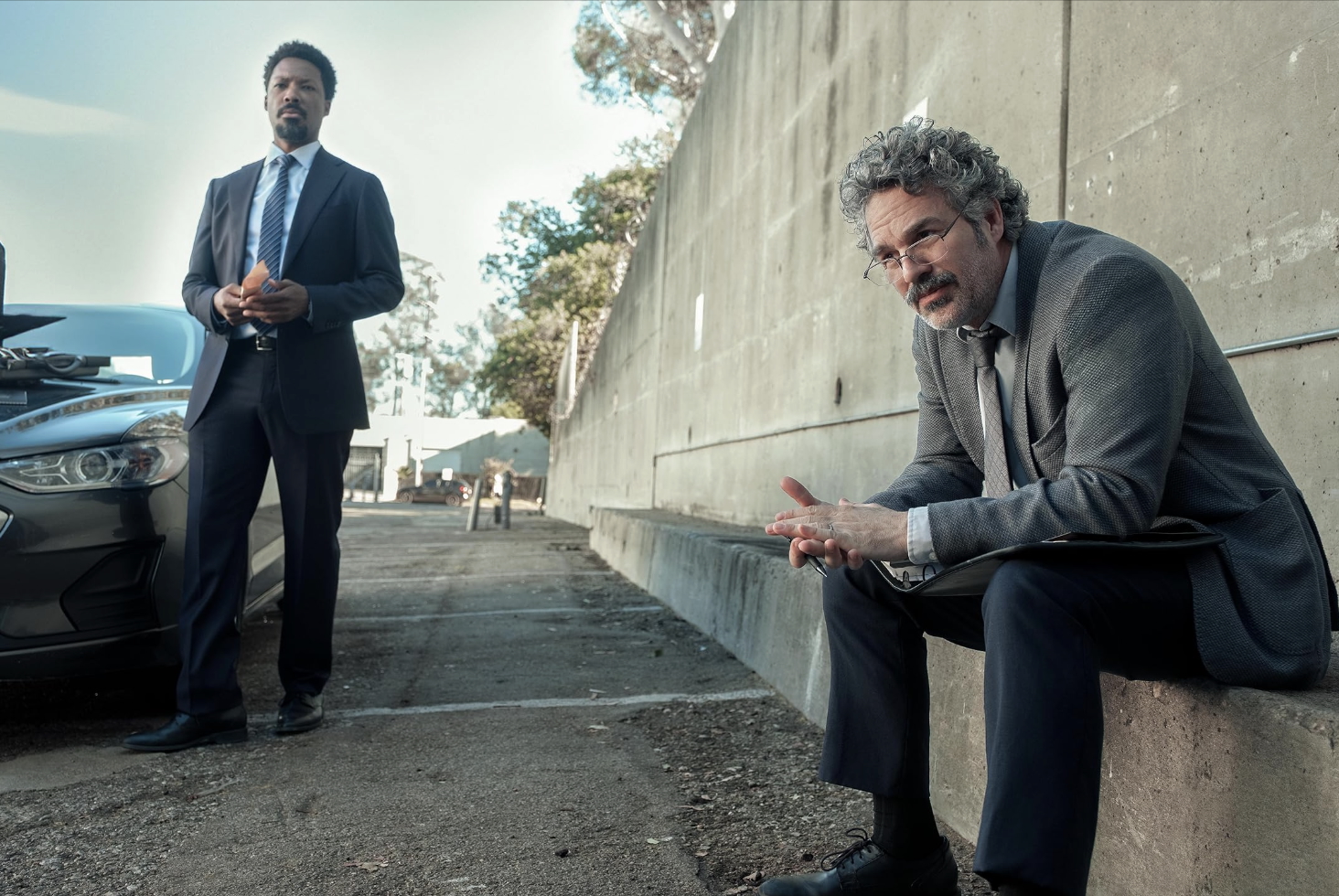
“Crime 101” is about a hunky jewel thief and the cop on his tail and the beautiful women caught between them, but it doesn’t come on as a knowing lark like the Don Winslow novella did. The Winslow story was a charming throwaway, a nod towards breezy capers like the “The Thomas Crown Affair” and various Elmore Leonard books.
By contrast, writer-director Bart Layton pitches his tent in Michael Mannville, modeling a moody character study after “Thief” and “Heat,” with a splash of Quentin Tarantino’s own unusually obsessive Leonard adaptation, “Jackie Brown.”
None of this fealty especially annoys me. “Heat” is to the LA crime film what “Chinatown” is to that city’s brand of noir: a giant to which dues must be paid. If a movie called “Crime 101” appeals to you, you probably accept this truth on a latent level.
The regret is that Mannville is a place visited by many filmmakers, while Winslow’s novels have a tone that has barely been broached onscreen. Oliver Stone’s Winslow adaptation, “Savages,” got the blend of hallucinatory violence with West Coast sexy chillitude about right. But that’s about it.
Winslow’s cartel trilogy has been nibbled at by Hollywood for years to no avail, as has his maybe even better dirty-cop novel “The Force.” And of course there’s Frankie Machine and many others. But I digress. Winslow’s work is a treasure trove awaiting its own talented fanboy auteur.
Davis (Chris Hemsworth) is in the tradition of Mann’s lonely master thieves who value the Work on an existential level at the cost of human relationships. Layton and Hemsworth mix up the formula a bit, as Davis has been imbued with social anxiety that codes him as kind of a nerd. Hemsworth doesn’t glorify Davis’s social estrangement as much as you expect, aiming for vulnerability. The actor has tried to prove his mettle outside of Thor by self-consciously playing against his looks before, and in “Crime 101” he gets there, giving a commanding human-scaled performance.
Lou (Mark Ruffalo) is the One Good Cop, who recognizes a pattern in thefts that are united by inside intelligence, non-violence and the 101 highway. Ruffalo has played detectives several times in his career, most unforgettably in “Zodiac,” and he is without peer in individualizing them. Here he leans into schlub mode, with a disheveled posture and soft middle and graying hair and misleading sideways intelligence that makes you wonder how Ruffalo has gotten this far without being offered a reboot of “Columbo.”
Sharon (Halle Berry) is in high-end insurance, selling coverage to ghouls who spend more on party favors than most of us see across a lifetime. She is refused partnership in her boys’-club firm, who condescend to her for being a woman who is aging out of bait status for her clientele. Given Berry’s supernatural beauty, one may have to take this suggestion on an article of faith, until one remembers the news and what demographic the rich parasites who run our lives are apparently drawn to sexually. Like Hemsworth, Berry is more vulnerable than you expect, giving her finest performance in years.
This trio is the bedrock of “Crime 101,” and they are united by feeling stuck by their professions in a rigged social system, a plot device that — traditional of crime movies —lends glamour to our ordinary feelings of being trapped by our jobs, our routines, our fears. Lou and Sharon have chemistry, attending the same yoga class while inching towards a sting operation. I wish Layton had leaned into that character stuff more often.

But Layton continues to surprise you.
Nick Nolte appears here briefly as the mystery man who employs Hemsworth, and he is joltingly lean and mean and smoothed back, his anger telegraphed by a rasp that seems to emanate directly from the realm of the damned. This meaty cameo is a treat from a director who seems to have a real fondness and respect for actors. Be warned bros: this isn’t quite the macho crime movie that you may be hoping for, but rather a solid character piece and a studio movie that’s been made with care for adults.
These vivid characters distinguish “Crime 101” as being especially high-grade brand Michael Mann karaoke, complete with nighttime vistas and metallic city chic. This is fluid work, as Layton uses the 101 as a visual motif to shift between protagonists. Characters here are integrated into the fabric of the narrative with more finesse than they were in last year’s choppy, stop-and-start multi-character genre piece, “Weapons.”
There are a few too many characters. Barry Keoghan’s Ormon is meant to bring volatility to the movie as a mad dog, but he seems beside the point, and the climax that puts him in his place is a disappointment. Monica Barbaro’s Maya is charming, but she might as well be called Love Interest. Layton’s channel surfing between these two threatens to dilute the tension between the central threesome, though this is a forgivable offense.
“Good Luck, Have Fun, Don’t Die” is about the end of the world, espousing Gen X-y contempt for phones and memes and young people who are proudly illiterate because of said phones and memes and all the other audio-visual debris that pollutes our minds 24-7. The cynical flippancy is right there in the movie’s annoying title, which is uttered aloud by characters several times lest we miss the point.
I share these resentments. It seems that A.I. has been designed to eliminate every element of culture that I value with little compensation. You know that these smart robots aren’t going to make medical treatment cheaper, for instance, because A.I. is promising to be the best weapon against the poor since American taxing policies.
Or maybe our hatred and paranoia regarding A.I. is the real weapon? Part of the ongoing media rage machine that keeps us angry and distracted and hopeless. And that’s chiefly why I don’t like “Good Luck, Have Fun, Don’t Die.” Its rage seems like merely more sludge for the machine; it stokes easy resentments, smugly.
The director is Gore Verbinski, who specializes in big, long, frenetic, impersonal blockbusters that fancy themselves as having attitude. The first three endless “Pirates of the Caribbean” movies are his, so is “The Lone Ranger.” His surprisingly restrained remake of “The Ring” in the early aughts feels at this point like a lost light.

It is the near future, and we are in a retro diner with a requisite motley crew of diners, played by Michael Peña, Zazie Beetz, Haley Lu Richardson, and Juno Temple, among others. In storms a sarcastic derelict billed as The Man from the Future, who is played by Sam Rockwell in capital letters. He’s dressed in rags outfitted with a lot of wires and mechanical mumbo jumbo. Think Bruce Willis in “12 Monkeys” without the poignancy.
This man warns us about a hopeless future brought about by a form of A.I. that’s invented by a boy. Some of the diners need to accompany him on a mission a few blocks away to talk this kid into installing safety protocols into his innovation. Somehow that thin premise is the basis for 140 minutes’ worth of comic thriller.
(The revolution is dependent on…safety protocols? It’s difficult to tell if that astonishing lameness is meant as intentional satire of hapless, impotent politicians.)
How does crossing the street to ask a boy not to destroy your society make it to 140 minutes? Each member of Rockwell’s team gets a flashback that operates as a mini episode of “Black Mirror.” I’ve had it with flashbacks too, as filmmakers use them too often as a crutch to dial up mystery where little exists, annihilating momentum. There are other bits of studied eccentricity meant to convince you that you are having a good time. For some reason the mangled toys of “Toy Story” are the boy’s security system.
If you believe that “Black Mirror” hasn’t been stale for years, this movie might work for you. On the other hand, I felt like I was watching it for most of a weekend.
“Crime 101” and “Good Luck, Have Fun, Don’t Die” are both in theaters everywhere.