

If anything is eternal it’s Dracula, who has appeared in hundreds of movies for a hundred years. Frankenstein isn’t far behind, and there’s a weird reassurance to this predictability.
Predictable they remain, though — there are only so many ways that one can reheat a can of soup. Now entering into the fray is Luc Besson’s “Dracula,” a few months after the release of Guillermo del Toro’s “Frankenstein,” and a month or so before Maggie Gyllenhaal’s “The Bride!”
Besson’s “Dracula” has the same WTF quality as his “DogMan,” as in you can’t quite tell how much of this madness is born from an intentional sense of humor. I’m guessing that any movie that has Christoph Waltz say things along the lines of “the fact that she’s old and allergic to God’s representatives is a symptom, not a disease” has a tongue placed somewhere in the vicinity of cheek. At times, the Dracula movie that’s most explicitly conjured here is Mel Brooks’ “Dead and Loving It.” But Besson keeps you wondering.
Waltz, who was also in del Toro’s “Frankenstein,” and thusly intensifying our sense of endless déjà vu while navigating an echo chamber, is Besson’s version of Van Helsing. I know you already know, but just in case: Van Helsing, billed as “the priest” here, is the famous vampire hunter who is tasked with delivering a bunch of boring exposition before leading the other boring, white-collar fuddy-duddies to kill Dracula, a centuries-old vampire running amok in Europe while searching for his lost love.
The lost-love shtick is not in Bram Stoker’s novel, but it became part of the Dracula home-brew kit around the time of the Jack Palance version in the late 1970s. But the production that owns Dracula’s woebegone routine is Francis Ford Coppola’s 1992 film, which featured Gary Oldman and Winona Ryder as lovers separated by centuries. That movie is an insane and amazing fever dream, a horny and poignant phantasmagoria that blended the language of silent films with the overwrought poetry of 1980s-era hair metal.
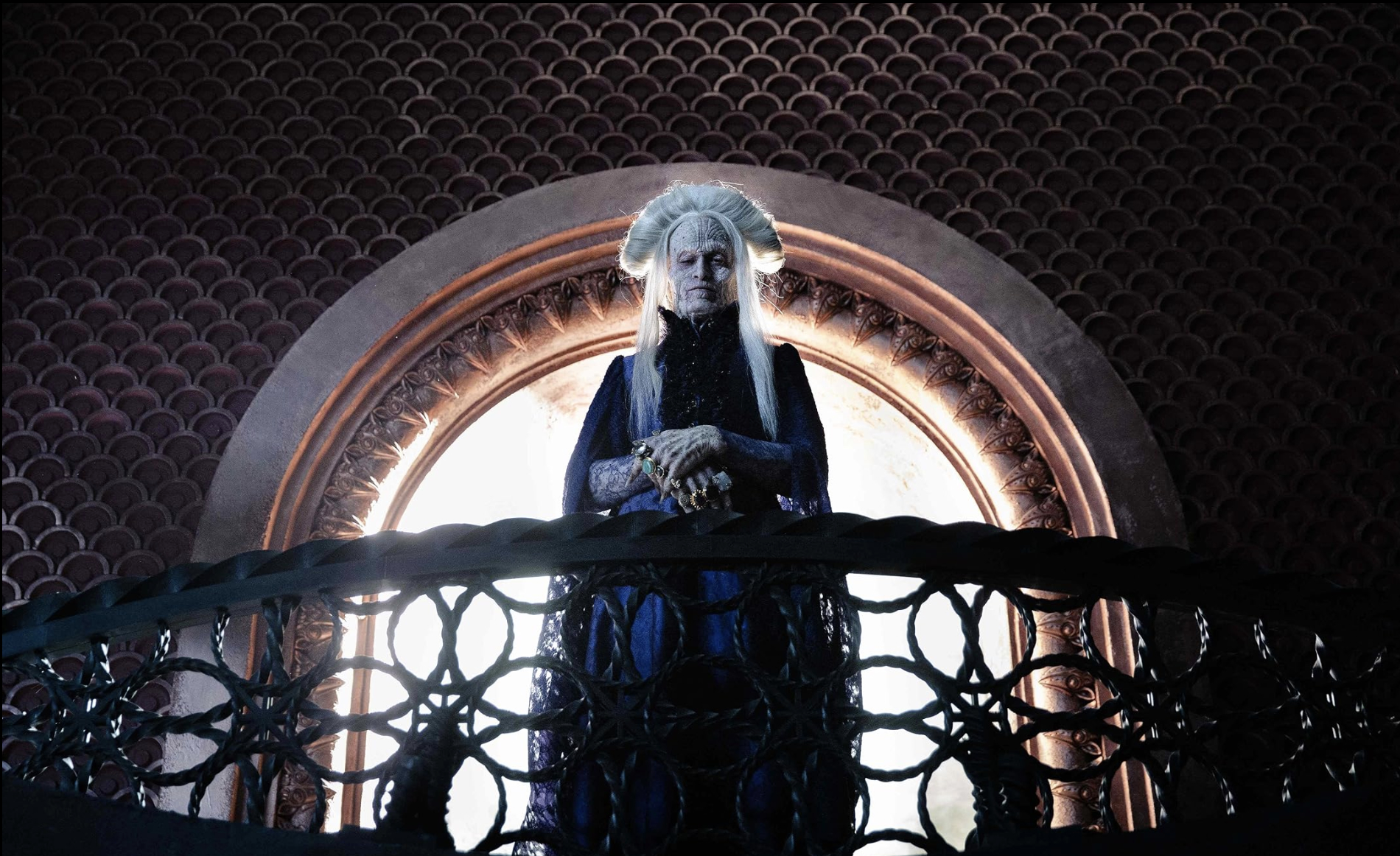
Besson cribs from the Coppola liberally. His Dracula, played by “DogMan” compatriot Caleb Landry Jones, is designed to resemble Oldman’s various incarnations, from withered crone to soulful hunk. Besson and Jones’ old-age Dracula is such an exact and inadequate copy of the Coppola character that you may, if you get the reference, laugh out loud. We’ve entered “Simpsons” land here, especially when Dracula kills a rat and drains its blood into a wine goblet while Jonathan Harker obliviously prattles on.
This old-age Dracula kinda grew on me. The absurd makeup and hoary Romanian accent ironically humanize Jones, a gifted oddball actor who usually gets on my nerves.
Jones’ inability to rise to the standards of the Gary Oldman Dracula almost seems to be baked into this movie as intentional subtext. For instance, when we first meet Dracula in the oldest of this movie’s olden times, he suits up for war in armor with a helmet that makes him look like a deranged bunny rabbit. When Dracula and his beloved Elizabeta (Zoë Bleu) make frenzied rounds of harlequin love, they stop for a pie fight. No they don’t, do they? I remembered them having pastry. I might have hallucinated some of this.
Besson’s indifferent screenwriting is a mixed bag. He brings little new to the party besides a cracked and perhaps self-compensating sense of humor, though thankfully, he can’t be bothered to pretend that you haven’t already heard this story dozens of times before, so he skips around between the big scenes and odd footnotes. Jonathan Harker, the blandest character in every version of “Dracula,” is barely explained here, and one appreciates the streamlining.

The script seems to have been dropped and pages filmed at random without accounting for what was lost — a grab-bag quality that allows you to fiddle with your Raisinets, wonder whether you texted your buddy back about that thing, and snap into semi-focus when something bonkers happens. Besson adds a subplot in which Dracula invents a sexy perfume to entice women across Europe, which almost but not quite turns into a Bollywood-style musical number. Dracula also has little computer-generated gargoyles who scamper around and help him, a lift from Disney that’s so random, and so at odds with the story’s sex factor, that you almost shrug in admiration.
Early scenes with Dracula at war feel low-rent and unpopulated, but the movie develops a surreal and rather pleasingly bright and ornate look that’s part-Coppola, part-Flemish watercolor, and part-Hammer, the studio that released those formative Christopher Lee Dracula movies starting in the 1950s. A cemetery here looks like an honest-to-god gothic set, with tombstones out of a gothic horror (or Tim Burton) nut’s dreams.
I had some fun with this thing.
It is much livelier than del Toro’s “Frankenstein,” a tedious and pedantic non-horror movie aimed solely at critics and the professionals who nominate him seemingly every other year for Oscars. It is also much more watchable than Dario Argento’s misbegotten Dracula from a decade or so ago. It’s as if Luc Besson landed a distribution deal based solely on the recognizability of the property and decided to doodle in the margins of canon. It might not be much, but these are barren times.
Corin Hardy’s “Whistle” is about an Aztec whistle that summons your death when blown. Ever see a shrunken head and wish it was a whistle that triggered your ironic demise? This movie is for you, though it wants for oddball details.
What we have here is a competent and indistinct blend of horror movies that traffic in the fashionable “trauma” trend. “Smile” and “Talk to Me” are all over “Whistle,” with a generous sprinkling of “Final Destination.” “Whistle,” however, has been outfitted with the wrong parts of these movies. It revels in the dreariness of “Smile” and “Talk to Me” without the poignancy or eeriness, and it has the convolutions of “Final Destination” without the playfulness that made last year’s “Bloodlines” a pleasant surprise.
It starts promisingly. The high school here and the surrounding woodsy town quietly boast the analogue credibility of 1980s-era horror movies. The requisite collection of motley alienated teens is more appealing than usual, and it’s nice to see Nick Frost as a stern teacher who thinks he might be able to profit from said Aztec death whistle.

Frost is not around for long, and he takes most of this movie’s sense of humor with him. Be advised: if you’re making a movie about a death whistle, aim for a sense of humor.
More precisely, the whistle prematurely conjures the death that you are meant to have. Huh? Let’s say that you are meant to die of lung cancer years from now. If you blow on the whistle that cancer arrives immediately. That gimmick reeks of “we need a little more here than just a whistle that kills you.”
The (nonsensical) specificity feels desperate, reverse-engineered for sequences of carnage that are passable yet neutered by the vanilla CGI that continues to be the bane of the modern horror movie. There is one death scene here that would’ve rocked the screen if it had been staged with analogue effects. In the 1970s or ’80s, Argento probably could’ve spun a masterpiece from this premise.
It’s at this point that I feel compelled to tell you that I’m an odd duck, a Gen X cinephile with a heavy interest in vintage horror who often prioritizes fetishy textures over stories. Most of you are going to prefer “Whistle” to Besson’s “Dracula.” The former is competent and dull while the latter is semi-amusingly ridiculous. Despite appearances, I do take the “consumer reporting” aspects of my duty seriously …
“Dracula” and “Whistle” are now in theaters everywhere.