

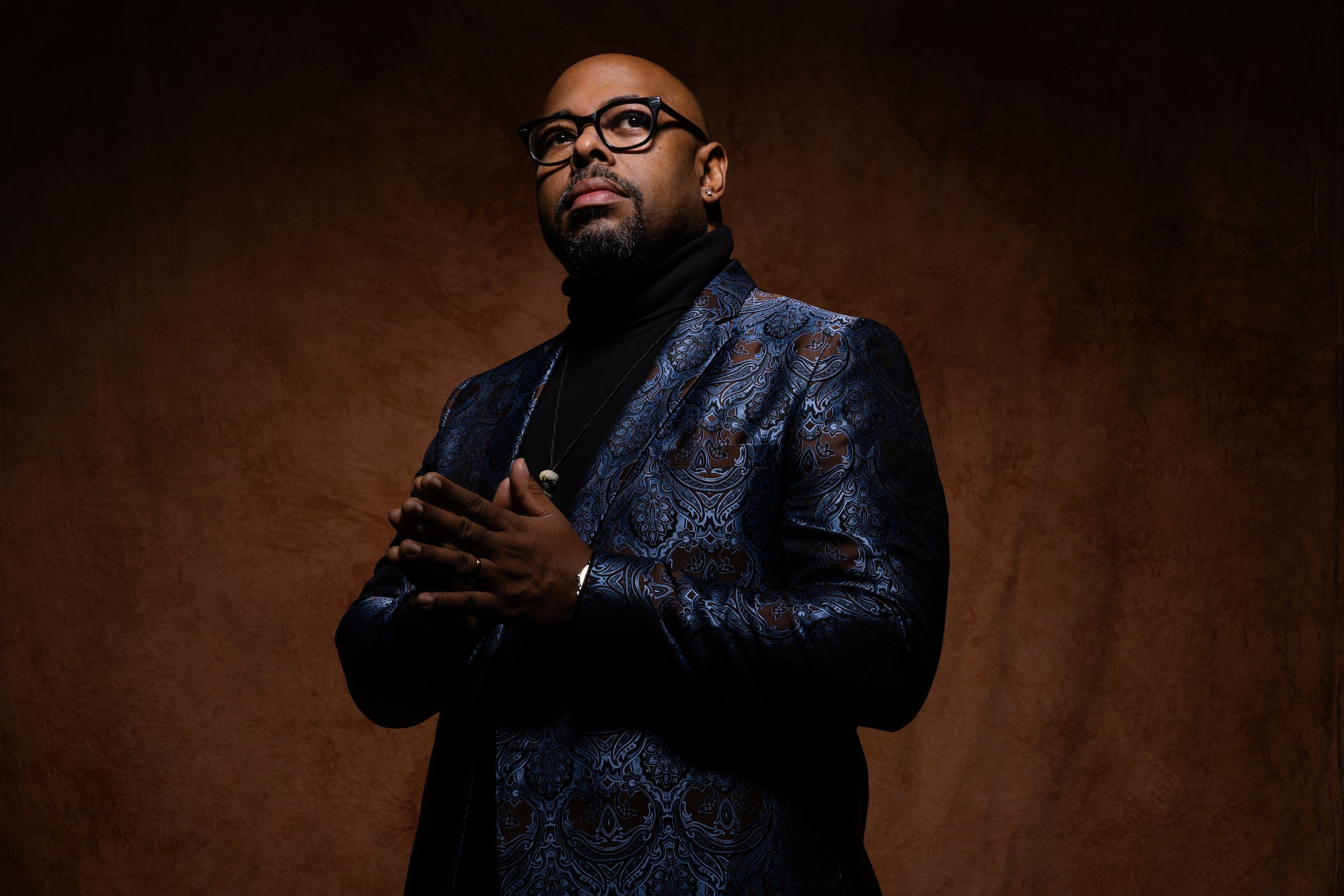
Virtuosic and wide-ranging bassist Christian McBride brings one of his finest bands to the Modlin Center at University of Richmond on Friday, March 31 – which will mark a grand return of sorts.
At the turn of the century, already a world-renowned player, McBride was artistic director of the University of Richmond’s June summer jazz series. Twenty years later, he is one of the premier players on his instrument, the artistic director of the Newport Jazz Festival, and, with NPR’s “Jazz Night in America,” the successor to Wynton Marsalis as the public voice of creative, improvised music.
“Richmond always holds a special place in my heart,” McBride says. “That was my first ever artistic directorship.” He was invited to lead the festival by former Modlin Director Kathy Panoff after appearing in a memorable 1997 performance with saxophonist Joshua Redman and drummer Brian Blade. (The album “Long Gone” with that trio and pianist Brad Mehldau was nominated for a 2023 Grammy.)
The next year, McBride was named artistic director of the Jazz Aspen, then started working with the Jazz Museum in Harlem, then the Los Angeles Philharmonic. In 2016, he was chosen by founder George Wein to take over as artistic director for the Newport Festival, the original crown jewel of American jazz festivals.
“Richmond always holds a special place in my heart. That was my first ever artistic directorship.” — Christian McBride
With his warm, deep, radio-ready voice, he had already done some on-air narration when an ailing Marion McPartland invited him to guest host on the 2010 final season of her venerable weekly “Piano Jazz” program. But his real trial by fire was when he was asked to host “Sound Check.” The show was recorded live in the afternoon on WNYC, New York City’s biggest and most popular radio station. McBride could have any guest he wanted, musicians, actors, athletes. But there would be no post-production editing to smooth out the rough spots.
“I saw my life flash before my eyes, literally right before we went on,” he recalls. “Around the same time I started doing my show on Sirius XM, ‘The Lowdown: Conversations with Christian.’ But that is just me talking with a friend, then we play duets. It’s edited down and becomes a radio show. But that [live] WNYC gig was the one that scared me half to death.”
If it was an audition, McBride passed. “In 2014, I became a permanent host of ‘Jazz Night in America,’ and we’re now in our ninth season.”

A prolific, wide-ranging career
The same charismatic openness that makes him the ideal radio host is reflected in his wide-ranging musical career. McBride has played on over 300 albums and won eight Grammys out of 16 nominations. In Richmond, he’s appeared twice with Pat Metheny’s all-star trio, leading the Mack Avenue All Stars in 2016, twice at the Richmond Jazz Festival, and for six years with his great post-fusion quartet and multiple guests at the Modlin Center summer festival. His local performances have paid tribute to the “two Browns” who were his primary inspirations: foundational jazz master Ray Brown (with whom McBride played in the “Superbass” trio) and iconic funk superstar James Brown. McBride once even went full classical with the Shanghai Quartet in a memorable performance of Schubert.
His latest band, Christian McBride’s New Jawn, more than lives up to the bassist’s exceptionally high standards. For those unfamiliar, “the Jawn” is the Philadelphia version of the French “je ne sais quoi”- a thing that either eludes or needs no definition.
“The New Jawn- you have to put a ‘the’ in front of it- was a 180 degree turn from my trio with Christian Sands and Ulysses Owens on drums. You go from a classic trio wearing suits and ties [and playing standards] to playing all originals and songs from Ornette Coleman and Larry Young that are more on the outskirts. I called in [drummer] Nasheet Waits, who I greatly admired but never had a chance to play with that often. [Trumpeter] Josh Evans had recommendations from just about everyone I talked to. I knew [saxophonist] Marcus Strickland well, I played with him many times in the past.”
The final ingredient for success can be found in the theater seats.
“The audience is like another band member, or they should be,” McBride explains. “I like it when they give some feedback. There has always been this mixture of fans who come from the non-classical world and a lot of people who are sort of what we call the fine arts audience, who listen but are not necessarily reactionary. I am a hybrid kind of guy. I want the audience to be boisterous, but in order for them to react, they have to listen.”
For example, he says his favorite concert of all time was at Oberlin College on that 1997 Redman/Blade tour. It was one of the rare college performances when the hall was full of students. “They were screaming and holding up signs and stamping on the floor with their feet before the band came on. It was like a rock concert,” McBride remembers. “They clapped when someone did something in the solos they liked and hushed up for the ballads. For the encore, a couple of students started throwing joints onstage. It was the greatest concert audience I have ever played in front of.”
Based on past appearances, this kind of wild behavior is not predicted for the Modlin show. But it will still present a great chance to see an incredible artist at the height of his powers.
Respect at 50
McBride says he really likes his age right now because he’s too young to be an old cat and too old to be a young one.
“Fifty is not 21, but it’s also not 70. I have a nice understanding and level of respect from both sides,” he says. “When I hear younger musicians, I get that youthful exuberance. I know what they are listening to because I try to stay up on everything that’s contemporary. But I know what I got from a lot of the great masters who they’ll never have a chance to know. So when they make their arguments – well, no, they don’t make arguments, they make assertions because they think they know everything – you have to listen. And then say: ‘When I was your age, and I played with Freddie Hubbard or Chick Corea …’ [and] now they are listening to you. You have to have that dialogue and openness. It’s so important to meet young people where they are.”
McBride’s unifying concept of improvised music as both frontier and legacy differentiates him from Wynton Marsalis, his more tradition-based predecessor, as the face and voice of American jazz. “I think [Marsalis’s] so-called ‘rigid’ view of the music was helpful and somewhat necessary. Look what he’s built with Jazz at Lincoln Center. Now [you] have a group of young people who actually know who Duke Ellington and Louis Armstrong are. He surely was sort of a lightning rod for younger brother generation- like Roy Hargrove, Joshua Redman, Mark Whitfield, Greg Hutchinson, James Carter, and me. We can always disagree on things, but I admire the man.”
If McBride is building on the foundation laid by Marsalis and others in the media meta-universe, the heart of his art remains fleeting, in-the-moment musical interactions that are focused on the players but also encompassing the listeners in the hall.
“The audience is always the thing that makes a special performance,” McBride says. “If they show up, and they enjoy it — and they let us know.”
Christian McBride’s The New Jawn plays the Modlin Center’s Camp Concert Hall in the Booker Hall of Music on Friday March 31 at 7:30 p.m. Adults are $35 and seniors $30. Non-UR Student/Youth $10 and UR students are $5. Tickets are available here.