

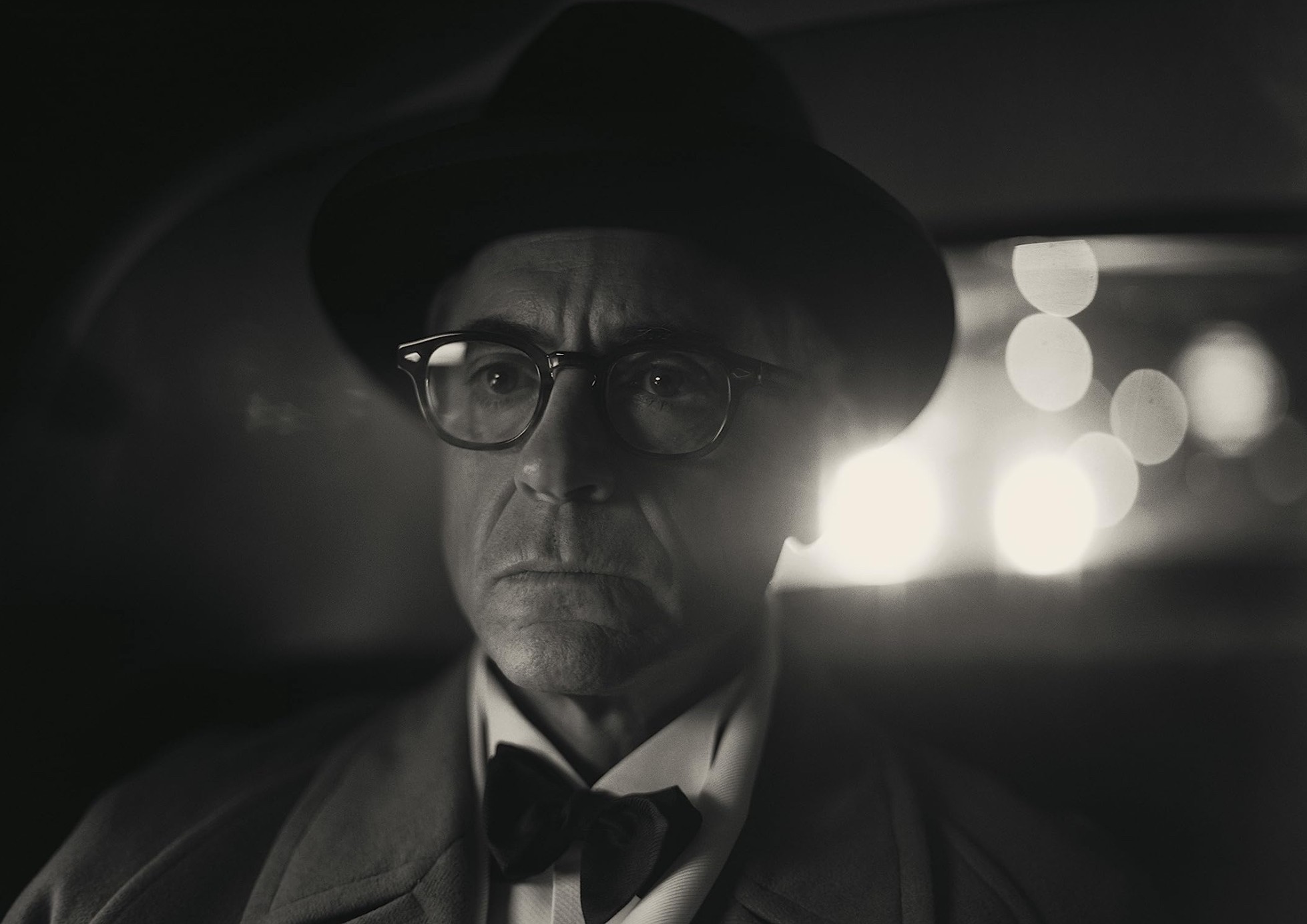
Even before the movie “Oppenheimer” officially opens Friday, critics around the world are hailing it as a super-sized masterpiece, a long overdue biopic that is both historically accurate and entertaining, a film that shows how science forever changed the history of mankind. Based on a true story, the three-hour film focuses on the development of the world’s first atomic bomb.
And the story features a local connection. The title character, J. Robert Oppenheimer, was born in Manhattan and is played by Irish actor, Cillian Murphy. But a central character is also that of Lewis L. Strauss, who was raised in Richmond, Virginia and is played by Academy Award-winning actor, Robert Downey, Jr.
Movie critics say that director Christopher Nolan presents a majestic and cautionary tale filmed in color and in black-and-white depicting the importance, intrigue and intensity of the multinational Manhattan Project and the subsequent use of the bomb on the people of Japan.
Oppenheimer and Strauss clashed repeatedly over politics, and over how to navigate the issue of nuclear weapons. Oppenheimer was a liberal academic, today most often remembered for being the first director of the Los Alamos National Laboratory, a then-top secret government outpost at which the atomic bomb was designed and tested.
Oppenheimer was a leading opponent of moving ahead with the hydrogen bomb and proposed a national security strategy based on atomic weapons and continental defense, while Strauss wanted the development of thermonuclear weapons and a doctrine of deterrence.
Liberal vs. Conservative
Oppenheimer was raised in an opulent Manhattan apartment surrounded by van Gogh, Cezanne and Gaugin paintings. He enjoyed all the amenities that a wealthy family with social status could provide. He received his undergraduate degree from Harvard University and Christ’s College, his PhD from Cambridge University of Gottigen.
Strauss was a noted conservative who served in the Navy and was given the honorific rank of rear admiral. He insisted on pronouncing his name straws, and was born in West Virginia, but raised in Richmond, Virginia. He grew up in the former capital of the Confederacy, surrounded by monuments and “Lost Cause” memorabilia.
Strauss was the son of a “shoe jobber,” who ran a wholesale shoe company. Both father and son would eventually become prominent philanthropists in Richmond.

Strauss was valedictorian of his class at John Marshall High School and, according to The Richmond Times-Dispatch, refused a scholarship to the University of Virginia because his family’s business needed his help.
He helped his father’s company survive the financial recession of 1913 that followed the creation of the Fed and income tax. Tired of selling shoes, and with his family’s blessing, he took a train to Washington, D.C. in 1917 and volunteered to work for free for Herbert Hoover’s Belgian Relief Commission.
While working with Hoover, Strauss attracted the attention of a partner at the prominent Wall Street investment firm, Kuhn, Loeb & Co. Hired at a five-figure salary, he soon proved his worth by helping the firm make huge profits in steel company financing.
By age 32, he made partner and soon became a millionaire. Strauss and Hoover remained life-long friends, a friendship that resulted in Strauss becoming a dedicated public servant who was appointed to the fledgling Atomic Energy Commission (AEC) by former U.S. President Harry S Truman.
Conflict with Oppenheimer
Fast forward to the outbreak of World War II and his conflict with Oppenheimer. It was both political and personal, an epic conflict between the scientist and the government bureaucrat that resulted in both men profoundly damaging one another.
In multiple pre-premiere interviews, Strauss actor Robert Downey Jr. described the relationship between the two men as “similar to that of Mozart and Salieri.”
William Obrochta, executive director of Beth Ahaba Museum & Archives, acknowledged in a phone interview that it might seem easy to vilify Strauss, but that to do so would be wrong. “Such thinking,” he says “precludes the possibility that real life events can cause people to question all that they thought was true at a given point in their lives.”
He explains that “people quite naturally remember Lewis L. Strauss as the controversial chair of the Atomic Energy Commission. But Strauss was also active in volunteer service and philanthropy. He served on numerous boards and was a Trustee of Hampton Institute (now Hampton University).
“He supported cancer research, donating heavily to the Medical College of Virginia. The Strauss Research Center at VCU Health is named in his honor. This, too, is a part of his legacy.”
By the end of each of their lives, both men expressed profound doubts about their respective roles in the creation of the atomic bomb and its subsequent use.
In an interview three years before he died in 1974, Strauss told the Associated Press, that he “deplored dropping the atomic bomb on Hiroshima.”
“I did my best,” he said, “to prevent it. The Japanese were defeated before the bomb was used. It was unnecessary and worse than unnecessary, it launched the world into the atomic weapons era.”