
If you stand at the entrance of People’s Bank on North 1st Street and look south, both the pain and promise of Richmond’s history unfolds.
Next to you, there’s a mural of Maggie Walker and, across the street, another mural honors famous figures from Jackson Ward’s past. On the horizon, the former Central National Bank (CNB) Building rises in all of its Art Deco glory.
The historic skyscraper was renovated almost a decade ago, a marquee mixed-use development that reflected the hope behind the newly minted Arts and Culture District. Formally established through a series of tax and regulatory incentives in 2012, the district designation sought to facilitate a bustling retail and residential resurgence along one of Richmond’s main thoroughfares.

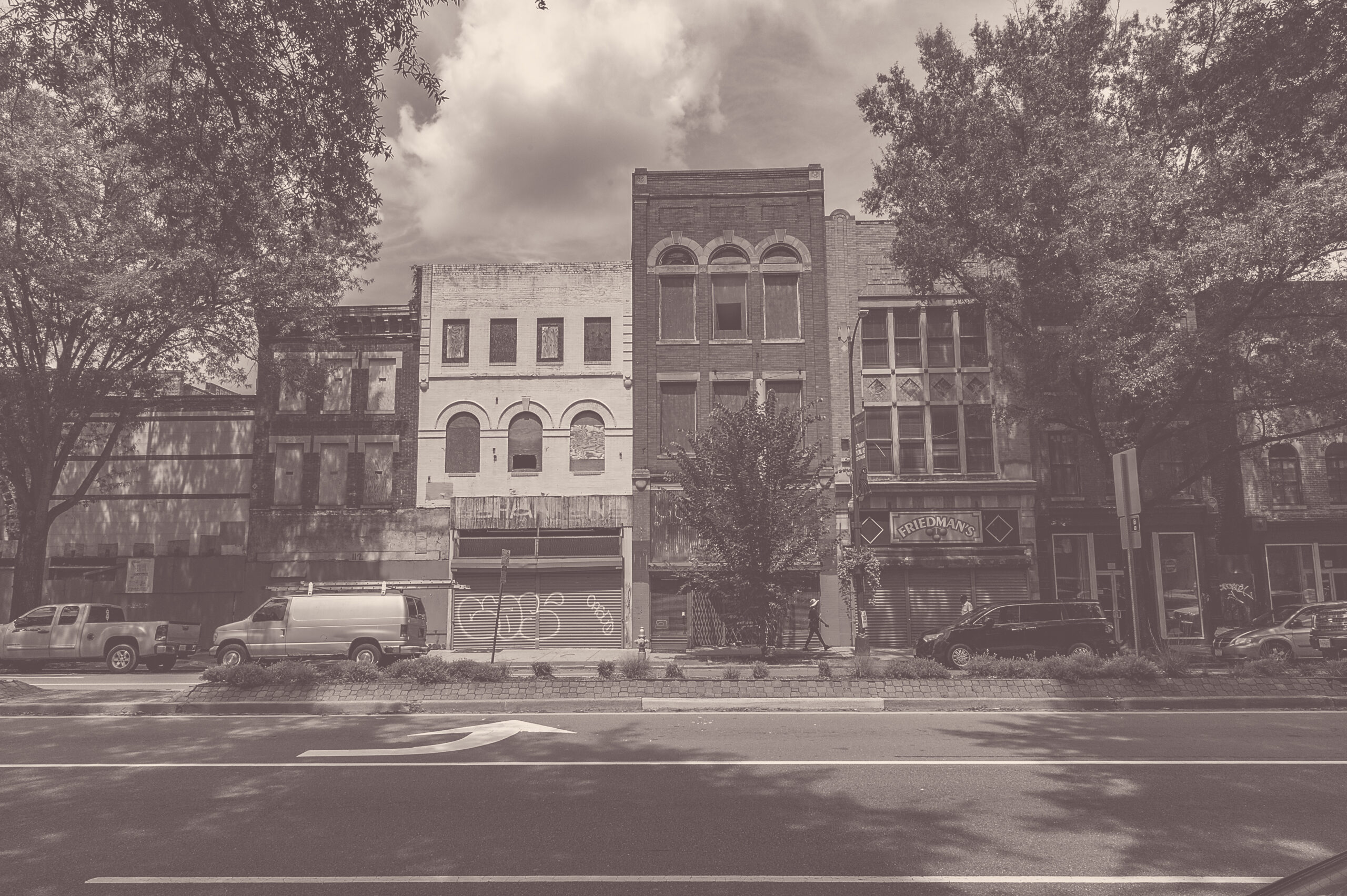
But in the middle-distance, ivy and weeds consume a block of buildings on the north side of Broad Street. Viewed from the front, the blighted, boarded-up storefronts are riddled with graffiti and at least one looks to be roofless. Some of these structures have been vacant since 2005 and merchants in the area are growing increasingly frustrated.
Bill Martin is the director of the Valentine Museum and a long-time advocate for Richmond tourism. He zeroes in on the 100 and 200 blocks of East Broad Street as the issue. “If you’re walking from the Valentine towards the Arts District, you have to pass through those blocks to get there,” he says. “The properties there could be key links to maintaining the vitality of the area.”
“Even the boards they put up that had murals on them have deteriorated,” says Liz Kincaid, owner of RVA Hospitality Group, which operates two restaurants on Broad Street, Tarrant’s and Bar Solita. Kincaid established the Arts District Business Watch last year, a group of business owners who meet regularly to discuss crime and safety concerns.
“We hear of other areas like Petersburg levying fines on building owners who let their property sit vacant,” she continues. “It seems like there are ways the city could be creating regulations or ordinances to apply pressure. But I think there’s also an argument that says, for these big developers, you’d have to apply a lot of pressure.”

The big developer sitting on the Broad Street buildings is Douglas Development Corp., the company that renovated the CNB Building. Owned by Douglas Jemal and run by his sons Matthew and Norman, the Washington D.C.-based developer acquired more than a dozen properties in downtown Richmond starting in 2005. Their purchase of the Dominion Building at 707 East Main last December for $19.25 million was hailed as the sale / acquisition of the year by CoStar.
Speaking from DC, Norman Jemal says his company is committed to revitalization in the Arts District. “Richmond has so much going for it, with CoStar bringing in thousands of jobs and the galleries and the theaters downtown,” he says. “We’re honored to be a part of it.”
He said specific blocks on Broad Street pose difficulties because of factors like construction costs and working within historic preservation regulations. But he pointed to the company’s recent development of 200 and 201 East Broad into 19 apartments, branded as Harper’s Flats, as a reflection of its commitment to the area. “We’re going to make something happen there,” he says.
Natalie Doss, who opened Natroganix Juice Bar and Flow Space at 105 East Broad last December, says she hears rumors of development but nothing concrete. Even though she was doing a brisk business on a recent Thursday afternoon, she says, “If those properties were developed, it would make a big difference.”
Conversation about development in the Arts District has intensified thanks to two major projects in progress. VPM [which owns Style Weekly] broke ground last year on a new headquarters at 13-17 East Broad. The five-story, 53,000-square-foot facility is scheduled to open early next year.

Meanwhile, the $253 million CoStar Center for Arts and Innovation has started to rise at the corner of Broad and Belvidere, scheduled to open its doors late in 2027.
“With VCU continuing to inch its way down Broad Street and with VPM coming in, I think that’s a very hopeful sign,” says Klaus Schuller, managing director at Virginia Repertory Theatre, which maintains its principal performance venue at 114 West Broad. “I hope we can start to reimagine the Arts District the way it should be: vibrant, bustling, full of independent businesses and the arts.”
Like many in the area, Schuller would welcome even temporary improvements that would mitigate the sense of neglect on those two blocks.
“Short-term uses like pop-up galleries, or if the storefronts were beautified to become a sort of walking art exhibit, anything like that is better than chain link fencing and boarded up façades,” he says.
Those kinds of measures have been the focus of Emily Smith, owner of 1708 Gallery and a member of the Downtown Neighborhood Association. “Even if tomorrow the Jemal family decides they’re going to develop those blocks, that’s years in the realization,” she says.
“The need right now is to create opportunities for people to engage with the neighborhood.”
Smith cites a recent national conference for ceramic designers at the convention center that worked with sites across many blocks of Broad Street to host pop-up shops and galleries. “We had over 200 people in our space every day,” she says. “It demonstrated to me what we all want it to feel like down here.”
“It’s not like without change things are going to hell,” says Smith. “It’s more that it’d be nice if we could get a little movement in that specific area.”

The City’s Steps
Richmond officials say they are working to address the issue.
In response to written questions about development on Broad Street, the City of Richmond’s deputy chief administrative officer for economic and community development, Sharon Ebert, provided detailed answers.
Ebert pointed specifically to the work of the Broad Street Task Force created in 2024. The group has focused on many issues including public safety — such as pedestrian lighting, helping unhoused residents access resources — and streetscape improvements like landscaping and tree well maintenance. [Full disclosure: VPM’s President and CEO Jayme Swain sits on this task force.]
The city is also applying to have Broad Street placed within the Commonwealth of Virginia’s Main Street Program, a state-wide initiative focused on revitalizing historic commercial districts. “This program is a proven pathway to transforming major downtown commercial corridors into vibrant places,” Ebert says.
Ebert says that six vacant properties were given Notices of Violations in a May 2024 sweep of the Arts district corridor, while another 21 vacant properties were identified for ongoing monitoring. But she notes that “[w]hile some buildings are in bad shape, as long as they remain boarded up and no façade materials are falling into the public realm, then they are not in violation of property management codes.”
In order to facilitate the kinds of improvements Emily Smith refers to (see main article), the city is pursuing expansion of the Commercial Area Revitalization Effort (CARE) program. Program funds can be used to support the cleaning and repairing of façades and temporary artwork or history storytelling installations.
In possibly her most hopeful response, Ebert says, “The Mayor and the City have had ongoing conversations with Douglas Development to encourage redevelopment in this corridor and are hopeful that we will have more to share on the future of these properties in the near future.”