

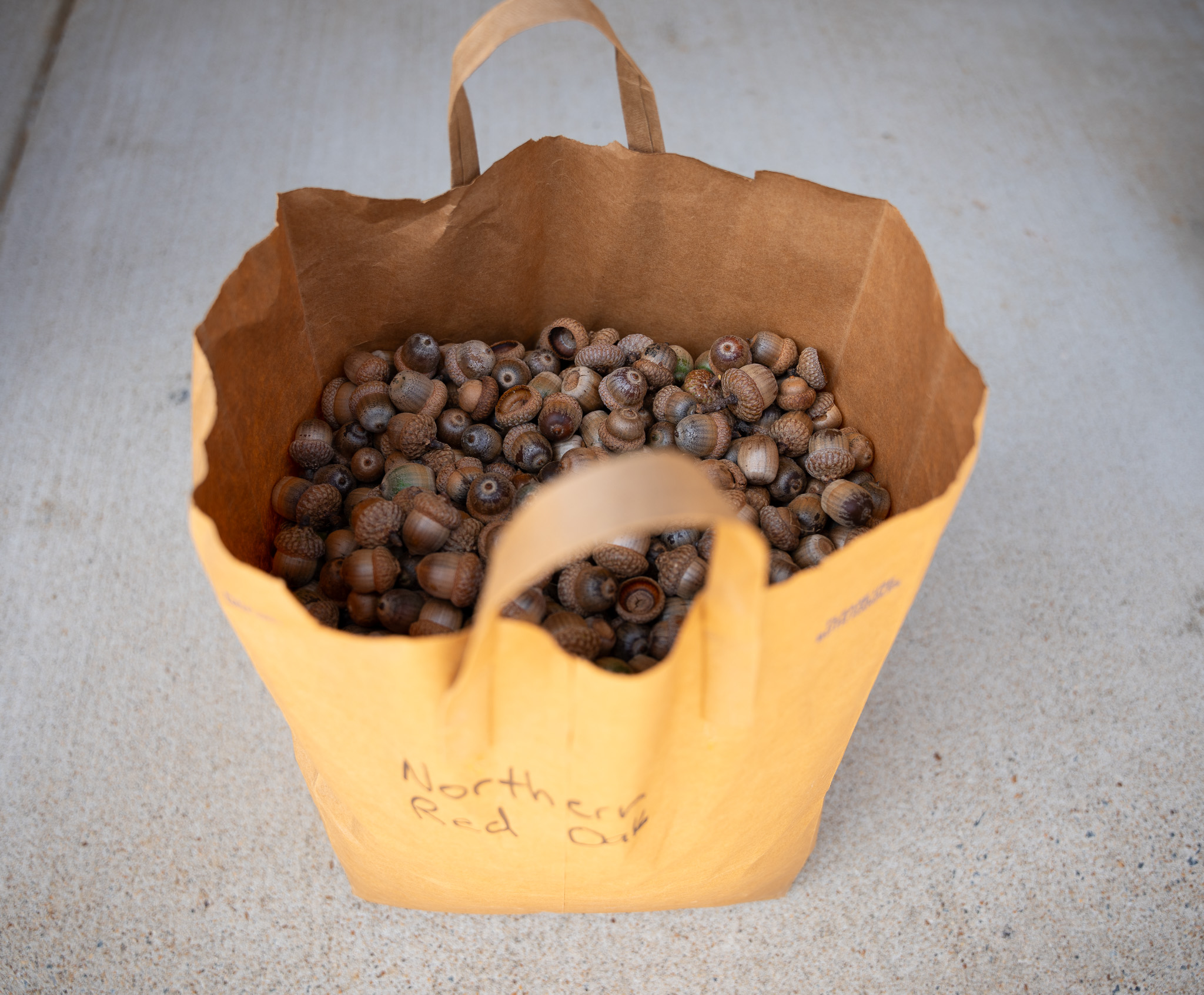
Want to help build the forests of tomorrow? Now’s your chance.
The Virginia Department of Forestry’s annual acorn and nut collection program is kicking off. Running until Oct. 15, Virginians are asked to collect and drop off acorns and nuts that will be grown for eventual home plantings, reforestation and research efforts across the commonwealth.
“Every little bit helps,” says Joshua McLaughlin, manager of the DOF’s Augusta Nursery where the donations are planted.
Chestnut oak, white oak, black oak and black walnut are the species of particular interest this year. The acorns and nuts can sometimes be scarce and tricky to find, and purchasing them can be expensive, like black walnuts which can cost up to $4 a pound.

“[Black walnut] we really rely on the public to provide,” says McLaughlin. “Two years ago [the public] brought so much walnut that, if we should have bought that, it would have been close to $50,000. That is one we’re really thankful to the public for.”
Others requested are bur oak, cherrybark oak, chinkapin oak, pin oak, northern red oak, southern red oak, Shumard oak, swamp chestnut oak, swamp white oak, water oak, willow oak, overcup oak and Chinese chestnut.
The Virginia Department of Forestry’s acorn and nut collection program began over a decade ago as the need for certain species grew.
“We started the acorn program years ago mainly because, one, seeds are expensive [and] we’re trying to increase our crop and the amount of replants. The more acorns we get the bigger the crop,” says McLaughlin.

But it wasn’t until around 2021 during the pandemic that things really took off as the public began delivering thousands of pounds of acorns. “There was one year [where] I’d never seen so many acorns in my life,” he says.
Once received, all donations are cleaned and blown with a fan to remove lingering debris and then soaked in water. “Typically, good acorns sink and bad acorns float so we scoop the bad ones off and keep the good ones for when we’re ready to plant,” says McLaughlin.
These are then sown around mid-October on 30 acres at the 186-acre nursery and meticulously watered, fertilized and monitored over the months, especially for insects, like leafhoppers, and root rot.
About a year later, seedlings are usually available for their new homes, whether that’s for a yard, reforestation project, buffer planting or research, like with the Chinese chestnut which is being studied for American chestnut recovery.

Acorn production fluctuates yearly with the weather being one of the biggest factors. Frost, rain and drought can stress trees halting growth, pollination or even cause acorns to prematurely fall. Other times, it’s just a game of patience as some species, like oaks, only produce large acorn quantities in mast years (those occurring every two to five years). This is why collecting as many as possible is truly important.
“A tree in the woods drops thousands of pounds of acorns; how many seedlings come out of that wooded area? Not a tremendous amount,” says McLaughlin. “They get eaten, hit by frost — little things. It’s amazing how every year we can take those acorns and get them to thrive.”
If interested in participating in the program, make sure to put all gatherings in a breathable bag, such as burlap or paper, to prevent mold and ideally label it with the tree species. If you’re not sure what tree is being collected from, the DOF has online identification guides available. One can also enclose the tree’s leaf in the bag which can help the nursery identify it. Make sure to keep one species per bag and as much debris out as possible (like twigs and rocks).
The bags should be delivered within 10 days after gathering either to the Augusta Nursery in Crimora or at a local DOF location. For the Richmond area, the closest are the Providence Forge and Aylett regional offices.
If you prefer to assist in another way, consider purchasing seedlings from the nursery. This option starts Oct. 1 and a variety of hardwood species are available, including native fruit trees and even some unique white oaks this year. These were grown from acorns taken from Virginia white oak trees at least 250 years old in celebration of the United States’ upcoming semiquincentennial.
All seedlings can be purchased through the DOF’s online store buyvatrees.com or by calling the main office at 540-363-7000.