

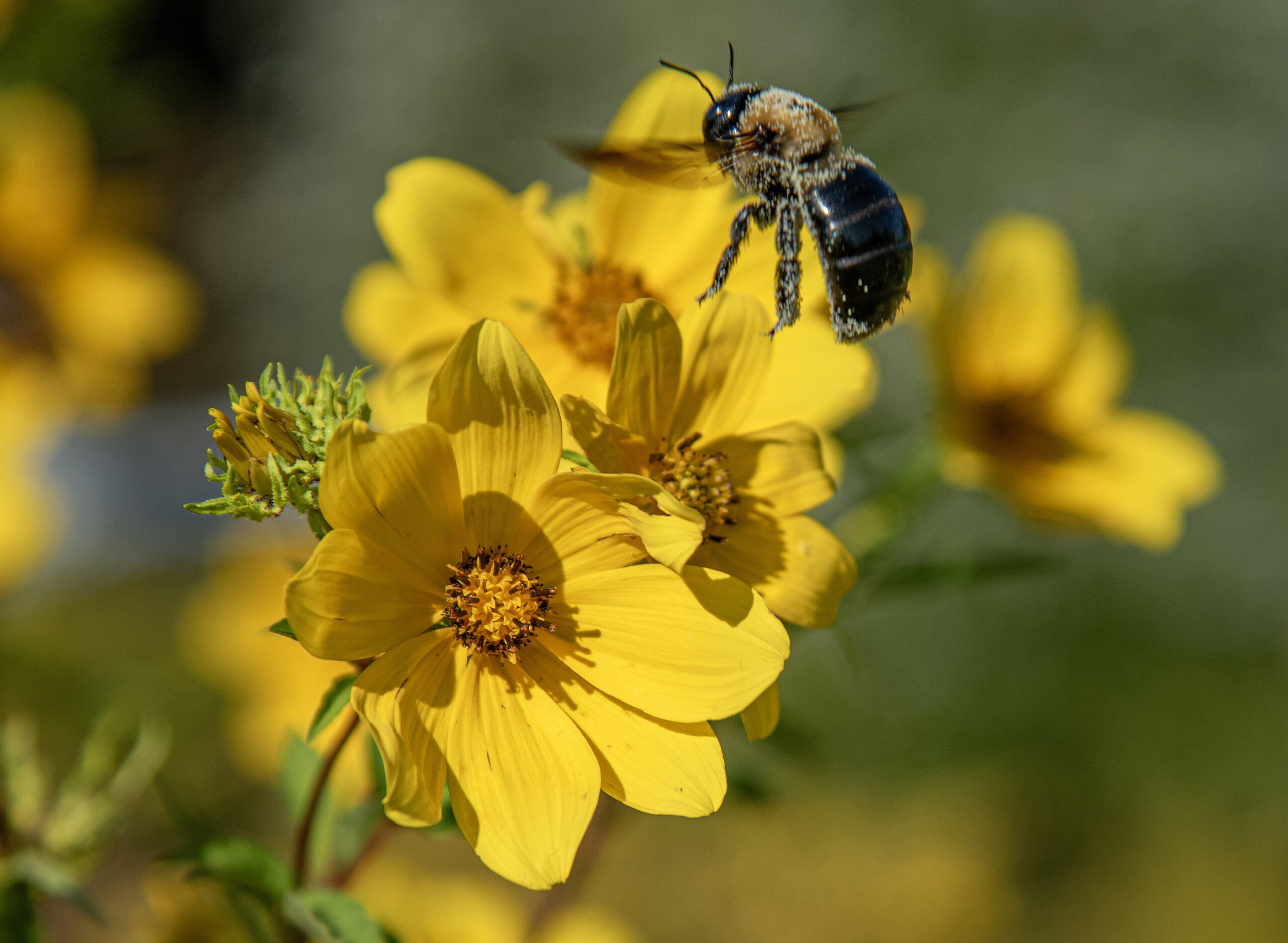
Bees, butterflies, moths — oh my!
Pollinators have been steadily appearing in Richmond thanks to various city efforts, including one very big move that hopes to transform the city into a pollinator paradise.
Since April 2024, Richmond has been a certified Bee City USA affiliate. An initiative of the Xerces Society for Invertebrate Conservation, the Bee City USA designation is given to areas that are focused on improving life for pollinators.
“[Being a Bee City] provides a network for the many pollinator stewards active in our city to learn from each other’s experiences establishing and maintaining pollinator habitat,” says Kate Rivara, community garden coordinator for Richmond’s Department of Parks, Recreation & Community Facilities. “It also formalizes our commitment to enhancing and protecting pollinator habitat by committing the city to adopting an Integrated Pest Management plan [and] provides resources from the Xerces Society and a network of other cities and campuses that will one day be connected by pollinator corridors.”

“We integrate Bee City principles into all of our work making pollinator-friendly practices central to the way we design, plant and maintain greenspaces,” says Shelly Barrick Parsons, executive director of Capital Trees. “We’re wrapping up the Hotchkiss Green project with the installation of a new pollinator berm this fall.”

As a Bee City, Richmond is required to follow certain commitments, like creating and enhancing pollinator habitats, implementing an Integrated Pest Management plan, incorporating pollinator-friendly city policies and hosting pollinator awareness events.
Another is to display at least one Bee City USA sign. “A sign has been installed at the entrance of Bryan Park as a gateway to our city since that park is along the northern border of Richmond and contains multiple pollinator gardens,” says Rivara. There’s also one at Fonticello Park which was added in June during National Pollinator Week to celebrate its habitat restoration work.
The community efforts have been buzzing so far. There have been pollinator habitat maintenance days, a BioBlitz at the Low Line to document insects and monthly Bee City tours hosted. “Stewards of pollinator habitats share the process used for establishing plantings which is a key part of success in transforming turf or former invasive-ridden areas, as well as the practices and challenges they experience with maintaining these sites,” says Rivara regarding the tours.

Going into the autumn, there are plans to add more pollinator-friendly plantings, install additional signage and start the process of writing an Integrated Pest Management plan that will guide the city on how to best reduce and eliminate harmful quick-fix pest removal methods (like pesticides) and instead look at long-term, non-toxic solutions.
“By creating greenspaces that increase biodiversity, improve habitat quality and welcome both people and pollinators, we support the widely held definition of sustainability, also emphasized by RVAgreen 2050, as meeting the needs of the present without compromising the ability of future generations to meet their own,” says Barrick Parsons.
Richmond’s journey to becoming a Bee City began around 2022.
“[Richmond Parks & Recreation] was approached by pollinator enthusiasts from area garden clubs after they heard about Lynchburg earning its designation,” says Rivara. “We launched the effort by inviting Heidi James to speak to interested members of the community at the Round House at Byrd Park about Xerces objectives and Lynchburg’s journey.”
The idea quickly gained traction and a Bee City steering committee was formed to customize a Bee City resolution that also environmentally aligned with the Richmond 300 master plan and RVAgreen 2050.

The City Council approved the measure in January 2024 and Richmond became a certified Bee City on April 21, 2024. Richmond is now one of 241 Bee City USA affiliates, joining nearby Ashland and the University of Richmond (a Bee Campus USA affiliate). Each year, the city must renew the designation and submit a report of the year’s work.
This move comes at a time when bees and other pollinators are declining, especially in urban areas, with one of the biggest culprits being habitat loss.
“Every time you put a building up, a new road or expand a sidewalk, whatever it is, you’re losing spaces where bees might be able to live,” says Matthew Shepherd, the Xerces Society’s director of outreach and education. This is especially harmful to ground-nesting ones, like bumblebees. By covering bare soil with hard surfaces or even heavy mulch, it impacts their access to nesting sites.
Despite challenges, pollinator conservation is taking off and is something anyone can get involved in, whether it’s planting a few nectar-rich plants or eliminating pesticide usage.
“One of the most satisfying things about pollinator conservation is when you bring flowers back in, provide nesting sites and protect areas from pesticides — the recovery can be quite striking [and] quick,” says Shepherd. “People plant flowers in the spring and by summer sit back and watch the bees.”
Interested in learning more about Richmond’s Bee City USA work? Follow their Instagram (@beecityrichmondva) or reach out to join their email list (beecityrichmondva@gmail.com) to receive updates on events, tour dates and volunteer opportunities.
“Pollinators touch our lives in many different ways, from the blueberries we eat at breakfast to the cotton sheets on your bed,” says Shepherd. “These simple, small insects really are foundational to the health of the environment.”