

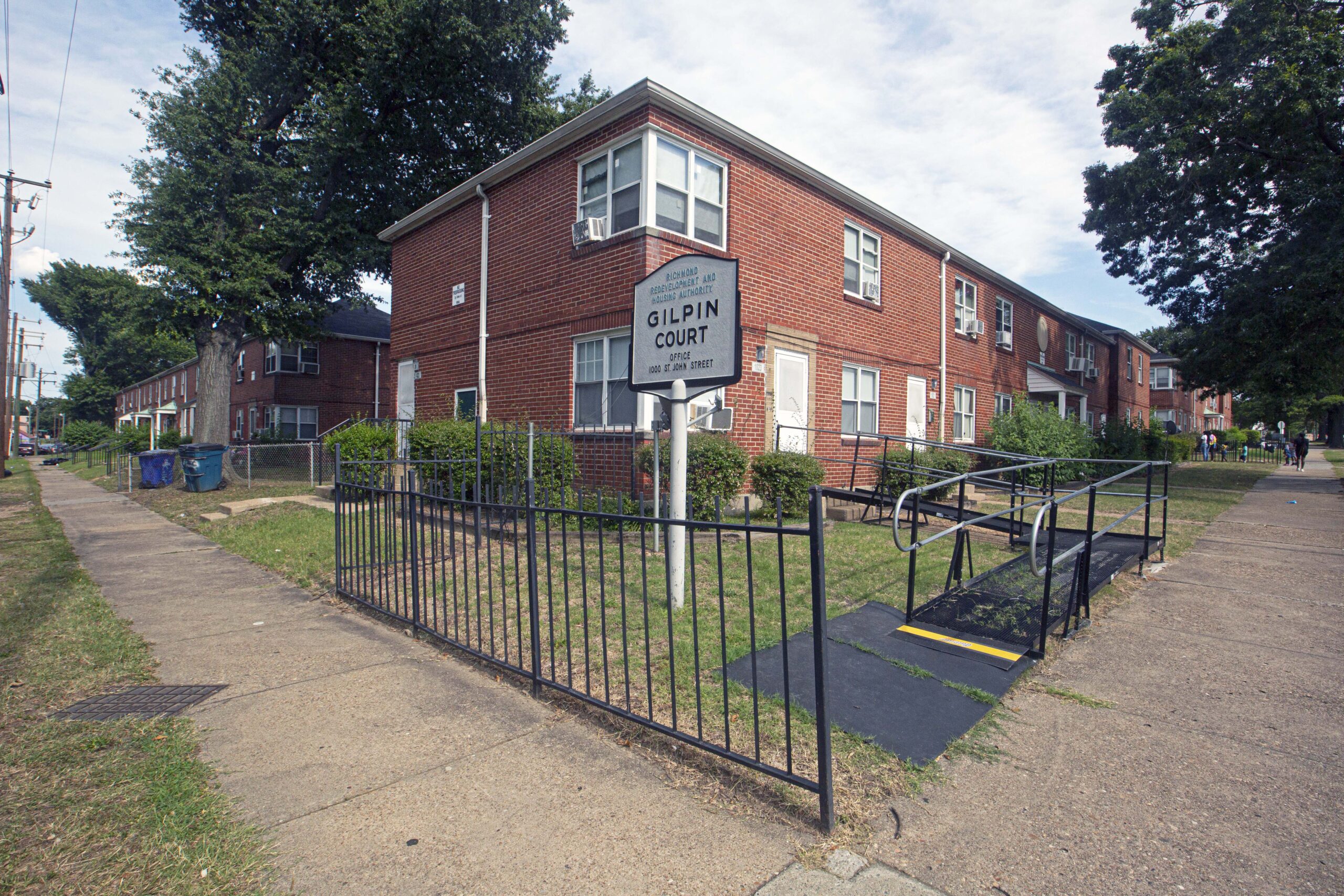
UPDATE: The RRHA Board of Commissioners voted Sept. 17 to delay a plan to transfer ownership of Gilpin Court that was long opposed by residents. Our latest “On Parenting” column asks Richmond officials to take a deeper look at what’s at risk and why it matters.
Our oldest just started kindergarten. It’s as fraught as we had been told.
Everything around us feels heightened. The dark hour at which we’re now rousing the house feels like midnight. Meanwhile, darkness is thriving in our news feed with Trump having declared a military takeover of Washington, D.C.
As this frightening reality comes to life in D.C. and other cities — where people are being forcefully acclimated to the government grabbing their friends and neighbors off the street — a slow-burn nightmare outside Trump’s paradigm has been picking up heat in Richmond.
Richmond’s Redevelopment and Housing Authority has long wanted to rid itself of publicly-owned Gilpin Court, whose operations are subject to the laws enforced by the Department of Housing and Urban Development.
This has been long opposed by Gilpin residents as the rest of Richmond — from the top down — had until just recently tacitly or explicitly approved.
The pitch is that a private corporation offering slots to private housing stock would breathe new life into a neighborhood that was built in the 1940s and allowed to fall into disrepair. Calls for “one-to-one” city-owned property replacement have spent years being sanded down to a promise of one voucher per one unit.
Real leadership, real work, and real money, could make this a reality. One need only look at Fox Elementary to see what happens when a community rallies to rebuild a totally burned-down building into something beautiful.

In this shell game currently proposed by RRHA, Richmond public housing residents will lose rights and lose certainty. With the rising popularity of “affordable housing” as a concept among developers and politicians, true brick-and-mortar, publicly-owned housing is a needed resource that the city should not squander.
As the school year kicks off, we as parents are reminded of a stark reality: What goes on at home children take to school. And if kids don’t have a place they can call home, everything else is a secondary issue.
The reality is that without true one-to-one, brick-and-mortar replacement of units, there will be thousands of parents raising families without guaranteed housing in a city with constantly rising costs. At a recent RRHA Real Estate Committee meeting, a proposed “affordable” housing development involves carefully manufactured funding to benefit the developers and three-bedroom units starting at $1,660 a month. A requirement to keep units “low-income” would expire in 30 years.
This proposed project is not the whole problem, but illustrates the insidiousness of a plan to demolish Gilpin. It’s been hard work, but RRHA’s carefully built plan to vanish Civil Rights-era housing leaves our neighbors’ fate to profit margins, and it would make Trump swoon.
This school year, as kindergartners hear “work hard” for the first time, the same challenge needs to be put in front of those who have let RRHA operate in the shadows. After years of the Richmond Mayor’s Office explicitly or otherwise giving RRHA’s (ever changing) CEO a green light to diminish its own mission, we finally have seen a sign from Mayor Danny Avula that he is beginning to listen, from a statement last Friday.
Avula’s statement is a step in the right direction. But it perpetuates the false narrative that affordable housing is public housing. These terms are not synonymous: Public housing belongs to everyone through their government, and affordable housing belongs to developers.
As parents and caregivers in Richmond, our job is to work hard toward the right goals. As RRHA’s Gilpin Court plan somehow lumbers onward, it’s past time to work toward something with Gilpin residents instead of against them. Those of us not living there shouldn’t tolerate bureaucracies such as RRHA pursuing agendas that harm Richmond families.
Catherine MacDonald is a gerontologist who studies growing up in modern society as part of her job at Virginia Commonwealth University (though her views expressed do not represent her employer). Her husband Tom Nash is a former Style Weekly reporter and proxy for FOIA nonprofit MuckRock (https://www.muckrock.com/). They share writing duties for the On Parenting column.